

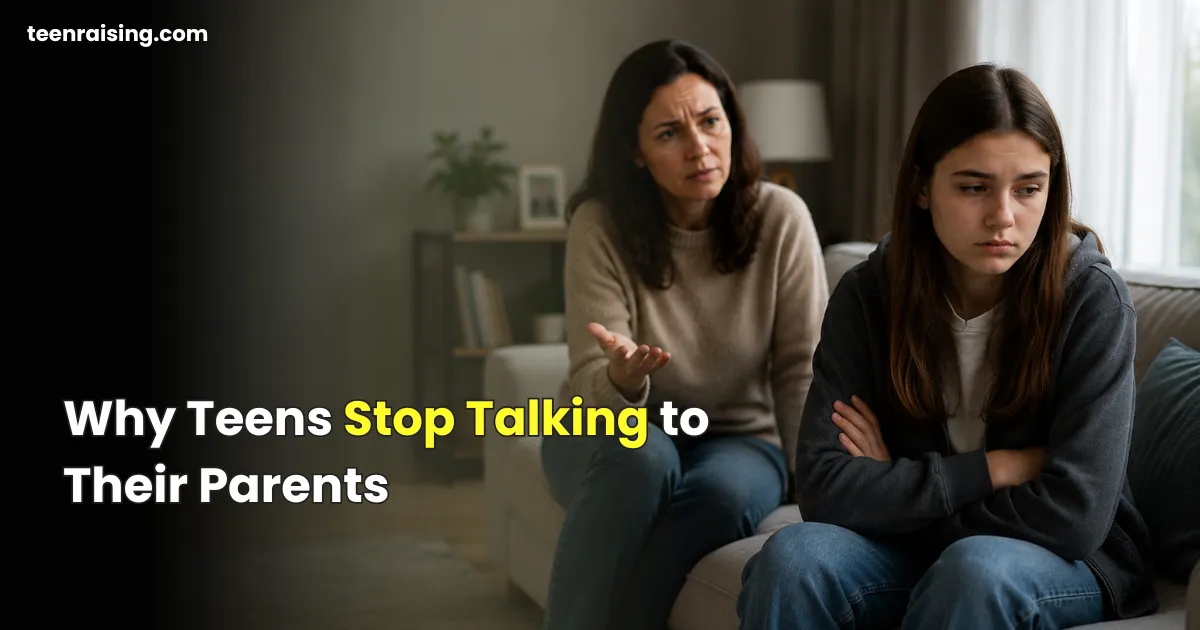
Why Teens Stop Talking to Their Parents: Understanding the Silence and Rebuilding Trust

One day your adolescent was always on and on about school, his/her friends and activities, but then suddenly everything was reduced to one-word answers such as “fine,” “nothing” or “okay.”
Are you one of those who has ever been wondering why teens stop talking to their parents? You should know that it is a common problem in the US for many families. If there is communication gap between parents and teens and no talk between you and your child, it means that he or she feels different emotions.
Teenage years are characterized by many changes physiologically, emotionally, and socially. In their quest for independence, adolescents tend to engage less in conversation with their parents. Nevertheless, once this trend becomes habitual, it leads to a communication gap between parents and their teenage children.
This guide will cover the top reasons teens stop talking, provide professional information, tell you an interesting true story, and provide tips on how parents may get through to their teens.
Why Teenagers Cease Communication with Parents
It is rare for teenagers to stop talking out of nowhere. Most of the time, their unwillingness to communicate is based on how they feel about themselves rather than their attitude towards their parents.
The following table summarizes the most common factors.
| Reason | What It Looks Like | What Parents Often Think |
| Desire for independence | Spending more time alone | “They don’t need me anymore.” |
| Fear of judgment | Avoiding personal conversations | “They’re hiding something.” |
| Stress or anxiety | Short responses and withdrawal | “They’re being rude.” |
| Constant criticism | Hesitating to share mistakes | “They’re ignoring my advice.” |
| Digital distractions | Talking more online than at home | “They care more about their phone.” |
| Lack of emotional safety | Keeping feelings private | “They don’t trust me.” |
The important thing to remember is that silence is often communication in itself.
Every Parent’s Story About Life
Sarah is a mother of a 15-year-old boy living in Colorado who realized that family dinners have been strangely silent recently.
Her son, Ethan, used to share all his stories with her, whether it was something amusing that happened at school or basketball training sessions.
When Sarah questioned Ethan on school, all he ever responded was,
“Nothing.”
Sarah thought that her son was being disrespectful and she asked even more questions.
This made Ethan pull back even more.
During one weekend, Sarah just sat down beside Ethan who was working on his bicycle without asking him anything.
It took nearly twenty minutes for Ethan to say,
“My school life has been pretty tough lately.”
The conversation went on for nearly an hour.
But later, Ethan confessed,
“I just didn’t want a lecture. I wanted someone to listen.”
And Sarah came to the realization that the problem was not that her son didn’t want to communicate – he just didn’t feel safe enough to do so.
Many parents go through something like this as well. In some cases, listening differently is what counts.
Also read: How to Talk to Your Teen Without Arguments: 10 Proven Communication Strategies for Parents
8 Most Common Reasons Teens Stop Talking and Sharing their Feelings
1. Because They Are Striving for Independence
The most common developmental objective among teenagers is independence.
As they grow up, they tend to depend on their parents less and make decisions on their own.
However, that doesn’t mean that they do not like their parents anymore.
They are just becoming independent.
2. They Feel Judged Instead of Heard
One of the biggest teen communication problems arises when all conversations become lectures.
Think about talking about something hard just to be immediately followed by such responses:
- “I told you so.”
- “That is because you never listen.”
- “You could have done that.”
Inevitably, many teenagers will stop talking.
If you’ve ever asked yourself why my teenager won’t talk to me anymore, this might be the reason.
3. They Do Not Want to Disappoint Their Parents
Teenagers hide mistakes out of fear of being punished or disappointed.
This is another reason why teens stop talking to their parents and why teens hide their feelings. They conceal their emotions, particularly when they are performing poorly at school or are depressed.
4. Psychological Issues Make Conversations Difficult
Stress, anxiety, depression, and burnout may make any communication seem like too much.
A troubled teenager will lack the stamina needed to express himself.
In fact, the American Academy of Pediatrics says that psychological withdrawal is sometimes one of the early indicators of a teenager needing help.
Patience goes much further than intimidation when it comes to creating an opening for communication.
5. Parents Intervene Without Listening More Often Than They Listen
Active listening helps build strong family relationships.
If parents tend to interrupt more often or instantly try solving every problem, teenagers can feel misinterpreted.
It usually makes the discussion more meaningful when listening comes first.
6. The Digital World Replaces Face-to-Face Interaction
Today’s teenagers live many of their lives on the internet.
Technology is not always the issue, but too much time spent looking at a screen can detract from important family conversations.
Many teenage communication problems now center around digital versus in-person interactions.
7. Family Conflict Causes Emotional Withdrawal
Why teens avoid their parents? Sometimes conflicts that never get resolved lead to emotional withdrawal in teenagers.
Eventually, they come to believe,
“Words don’t matter.”
It is for this reason why teens become distant and withdrawn after constant conflict.
8. They Simply Don’t Know How to Explain their Strong Feelings
Teenagers feel strongly but sometimes don’t have the language to articulate what they’re feeling.
They refrain from saying,
“I’m overwhelmed,”
and choose silence instead.
Also read: 12 Active Listening Skills That Will Help Parents Talk with Teenagers
Teen Signs Showing Need for Help Despite Being Silent
Silence doesn’t always give the only hint.
Here are some of the signs to watch out for:
| Emotional Signs | Behavioral Indicators |
| Mood swings | Spend more time in their room |
| Irritability | Do not participate in family events |
| Loss of confidence | Spend too much time on the internet |
| Anxiety | Low academic performance |
| Feeling overwhelmed | Oversleeping or insomnia |
If multiple signs persist for weeks, it might be appropriate to softly intervene or get help from professionals.
What Usually Causes Parent-Teen Communication Problems?
| Cause | Estimated Frequency* |
| Fear of judgment | ███████████ 85% |
| Desire for independence | ██████████ 80% |
| Academic stress | █████████ 70% |
| Mental health challenges | ████████ 60% |
| Family conflict | ███████ 55% |
| Technology distractions | ██████ 45% |
Chart representing illustrative representation based on popular themes from research in adolescent psychology. This is meant to illustrate comparative commonality rather than exact statistics.
How to Get A Teenager to Talk to Their Parents Again
The good news is that it is possible to rebuild communications.
Here are some strategies that will help.
Listen More than You Talk
Rather than always trying to solve the issue right away, consider asking your teenager,
“Do you want advice or just someone to listen to?”
Pick the right time
Teens tend to speak up more when:
- they’re driving together
- going for a walk with the dog
- making dinner
- working on housework
Making eye contact isn’t always required for good communication.
Don’t Make Each Discussion a Lesson
Not all discussions require a lesson.
At times, teenagers need empathy only.
Respect Their Privacy
Being independent means having your own space.
Respecting boundaries enhances trust in the long run.
Maintain Your Cool in Hard Talks
When parents get angry each time an issue arises, then kids know how to stay away from hard talks.
Keep Being There
It is important.
Despite the fact that today’s talks may be brief, you build trust in the future.
That is one of the best ways how parents can encourage teens to open up and make their child comfortable enough to share their inner feelings.
Also read: Parent-Teen Communication: 15 Proven Ways to Build Stronger Relationships
How to Improve Communication with Your Teenager
Even if communication is already failing, don’t despair.
Little things can make all the difference.
| Daily Ritual | Why It Works |
| Have one meal together | Promotes natural conversation |
| Be silent for 15 minutes without cell phones | Displays complete focus |
| Ask open-ended questions | Fosters longer responses |
| Celebrate little achievements | Boosts confidence |
| Acknowledge your mistakes | Demonstrates vulnerability |
| Value their opinions | Establishes trust |
These basic behaviors gradually reveal the way to re-establish a strong relationship with your teenager.
When Should You Take Your Teen to See a Doctor?
In case your teenager becomes totally withdrawn for weeks along with symptoms such as:
- constant sadness
- a marked change in personality
- withdrawal
- failing grades
- loss of interest in all activities
- talking about hopelessness or hurting himself/herself
you should consider getting professional help from a doctor or psychologist.
It may prove to be significant.
Reliable Sources for Parents
If you need reliable advice about adolescent development and communication, check out these sources:
- American Academy of Pediatrics – HealthyChildren.org: https://www.healthychildren.org
- Child Mind Institute: https://childmind.org
They provide valuable information about the adolescent mind, effective communication, emotional growth, and methods of parenting.
Final Thoughts: Each Discussion Begins with Feeling Safe
Wondering why teens stop talking to their parents? Just because they’re silent doesn’t necessarily mean that they’ve stopped loving you.
Actually, it usually means that they are dealing with difficult feelings, trying to become independent, or uncertain whether you’ll understand them.
And the best part of all is that trust can be rebuilt. Through active listening, acceptance of their newfound independence, and making emotional connections, parents can start bridging the communication gap between them and their teens through each conversation.
The progress may be gradual, but each and every calm reaction, dinner table, and listening moment will send the same message,
“I’ll always be here when you want to talk.”
Sometimes, the message is more important than the words.
Also read: Questions That Get Teens Talking and Strengthen Your Connection

Geetika Pandey
As a working mom and content writer, I know the joy, guilt, and constant balancing act that come with raising children while building a career. Through my writing, I share practical parenting advice, heartfelt stories, and real-life solutions to help busy parents create stronger family connections—one meaningful moment at a time. Follow on: Instagram