

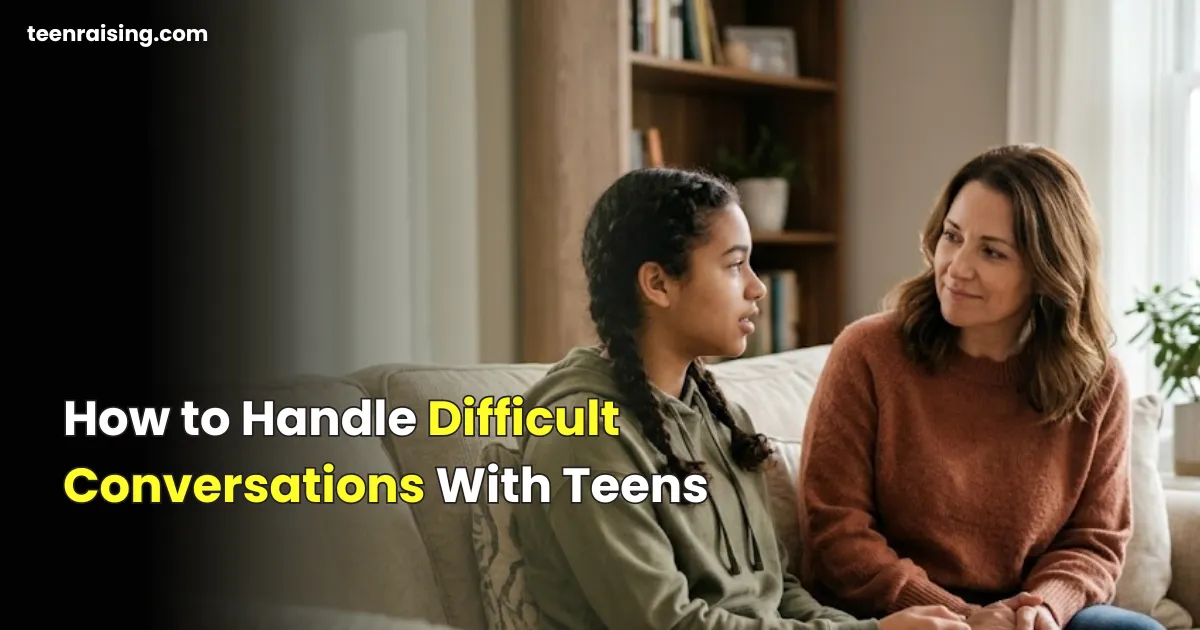
How to Handle Difficult Conversations With Teens Without Causing Arguments

Parents tend to assume that the teenage years would lead to more substantial discussions concerning school, friendships, mental health issues, dating, social media usage, and future aspirations. However, what parents may not anticipate is how fast those conversations will go silent, result in frustration, or become confrontational.
If you have heard your teen say, “You just don’t get it” or “Let’s not talk about this now,” you are not alone.
However, the positive point is that such difficult conversations with teenagers do not have to end in disagreements. In many instances, how one starts a discussion is far more important than what is discussed. If teenagers feel valued rather than condemned, they will be more willing to communicate and stay connected.
This guide addresses some of the most frequently asked questions by parents of how to handle difficult conversations with teens concerning dealing with challenging talks with their teenagers, with expertly proven tips and practical ways to do just that.
Why Is It So Hard to Have Tough Talks During Adolescence?
Adolescents are at one of the most crucial stages of emotional and brain development. Their abilities to regulate emotions, think long-term, and restrain themselves are not yet fully developed. On top of that, they have to strive for independence but still need help from their parents.
Such a combination makes even the simplest conversation emotional.
Some common subjects that may become challenging and difficult parenting conversations include:
- Academic results
- Usage of electronic devices
- Friends
- Boyfriends/girlfriends
- Mental issues
- Drug useStaying out late
- Family obligations
- College/career plans
Instead of looking at such conversations as confrontations, look at them as an opportunity to build your relationship.
Expert Perspective: The American Academy of Pediatrics advises parents to engage in discussions in a curious and empathic manner instead of lecturing or punishing the teen. When teens are made to feel emotionally safe, they are more willing to share.
At a Glance: What Helps vs. What Hurts?
| Style of conversation | Likely Teen Reaction |
| Quiet, curious questioning | Opens up slowly |
| Lecturing | Is not listening anymore |
| Active listening | Begins to trust |
| Criticism | Defensive behavior |
| Validation | Felt understood |
| Interrupting | Blocks communication |
Main Point: Tone is usually more important than words.
How Can I Begin a Tough Conversation with My Teen?
Beginning is generally the toughest part. Many parents tend to start with instructions, complaints, or questions that can corner teens.
The first step should be establishing a safe atmosphere.
Use these icebreakers:
- “Do you have a few minutes to talk? I’d like to get your point of view on this.”
- “I’ve seen you looking rather stressed. How’s everything doing?”
- “I’m not trying to scold you; all I need is to hear what you think.”
- “Whenever you’re ready, I’ll be right here.”
These introductory phrases sound much less intimidating as they offer an invitation to dialogue.
Some tips for handling difficult conversations with teens
- Choose a peaceful moment – not during a fight.
- Don’t begin important conversations when they’re tired and distracted.
- Position yourself beside them, not opposite them.
- Talk softly and calmly.
- Remember to be prepared to listen more than talk.
Also read: Parent-Teen Communication: 15 Proven Ways to Build Stronger Relationships
Example from Real Life
There was a woman named Sarah who was the parent of a 15-year-old boy in Texas.
The first thing that came to her mind was to question him saying,
“What is wrong with you?”
However, she waited till they drove together and asked,
“I’ve noticed that you have become quite quiet recently. I am here if you need someone to talk to.”
He was initially shrugging off, but after 10 minutes, he started to talk about his problems with friends at school.
If she would’ve started by questioning him, then there wouldn’t have been any conversation at all.
Tip for Parents
Remember that you are there to open doors, not to shove your teenager through.
Why Listening Matters More Than Advising.
A lot of parents think they are supposed to solve the problem.
However, adolescents prefer being heard to receiving solutions.
Parents’ attempts at immediate advising can be perceived by adolescents as indifference to their feelings.
Listening conveys:
- “Your feelings count.”
- “I’m trying to understand you.”
- “We’re on the same side.”
This subtle change is one of the most powerful and effective communication strategies for parents that can be used.
The 80/20 Principle
The following principle will help you:
| In Difficult Talks | Be Sure to |
| Listen | 80% |
| Talk | 20% |
The more he talks, the more he tells you, and the less he resists.
Instead of Saying…
❌ “You should have known better.”
Say:
✅ “Can you help me understand what happened here?”
❌ “You are making a poor choice.”
Say:
✅ “Can you tell me what you think might happen when you do that?”
Example of Mini Conversation
Teenager: “School doesn’t matter.”
Parent: “Why do you feel that way?”
Teenager: “Nothing I do is good enough.”
Parent: “That must be very frustrating for you.”
Advice comes only after listening.
Also read: How to Talk to Your Teen Without Arguments: 10 Proven Communication Strategies for Parents
How do Parents Discuss Sensitive Topics with Their Teenagers without Creating Conflict?
Regardless of whether you’re discussing and talking to teens about sensitive issues such as relationships, smoking, drinking, anxiety, bullying, and social media with teenagers, your aim shouldn’t be to “win.”
Your aim should be to keep the conversation going.
Parents usually fall for either of the following mistakes:
- Asking many questions at once.
- Converting every conversation into a lecture.
- Having preconceived ideas about the entire situation.
- Reacting without understanding the whole issue.
The “L.E.A.D.” Method
| Step | What to Do | Example |
| L – Listen | Give your teenager the opportunity to speak. | “Tell me more.” |
| E – Empathize | Recognize their feelings. | “That sounds tough.” |
| A – Ask | Ask open-ended questions. | “What were you thinking about there?” |
| D – Discuss | Solve problems together. | “How do you think that could help next time?” |
This method promotes positive parenting strategies since it fosters cooperation rather than control.
Successful Rate of Communication
(A Representational Model on the Basis of Research on Communication that Fosters Collaborative Parenting and Listening.)
| Parenting Approach | Likelihood of Positive Conversation |
| Lecturing | 30% |
| Criticizing | 20% |
| Asking Open Questions | 70% |
| Active Listening + Validation | 90% |
Insight: Teenagers are much more likely to participate if they are listened to before being led.
Takeaways
- Approach your teenager with questions rather than answers.
- Do more listening than talking.
- Affirm your teenager’s feelings before giving any advice.
- Use open-ended questions to facilitate conversation.
- Keep in mind that building trust is about small conversations, not one big talk.
How do you communicate with a stubborn teenager?
One of the hardest things when it comes to parenting challenges is trying to figure out how to communicate with a stubborn teenager. The harder that the parent tries, the more stubborn the teenager becomes.
However, what appears to be stubbornness can actually be something else.
The teenager is:
- Simply trying to assert his/her independence.
- Having fears about judgment.
- Covering up his/her emotions.
- Feeling misunderstood.
- Having trouble expressing him/herself.
Don’t ask yourself, “Why are you such a difficult kid?” Instead, ask,
“What could my teenager be going through?”
Avoid Struggle for Control by Engaging in Partnership
The impulse of any parent is to solve an issue immediately. But teens will be more cooperative when they are included in the solution process.
Don’t use:
❌ “Because I said so.”
Instead:
✅ “Let’s solve this together.”
Don’t use:
❌ “You are not listening.”
Instead:
✅ “I’d like to know why it is difficult for you.”
A Helpful Comparison
| If Your Teen Says… | Avoid Saying… | Try Saying Instead… |
| “Leave me alone.” | “Don’t talk to me like that!” | “I can give you some space. Let’s talk later today.” |
| “You don’t understand.” | “Yes, I do.” | “Help me understand your side.” |
| “It’s none of your business.” | “Everything is my business.” | “I care because I love you.” |
| “I’m Okay.” | “I know you are not telling the truth.” | “You can talk to me whenever you are ready.” |
Notice that the goal isn’t to “win” the conversation. It’s to keep communication open.
Real-life Example
Mark, a parent from Ohio, had constant arguments with his 16-year-old daughter regarding her phone usage.
Each time, their conversation went like this:
Parent: “Put away your phone.”
Teen: “Don’t control me.”
The debates only grew louder each week.
On one particular weekend, Mark decided to take a new tack.
Rather than delivering yet another speech, he asked,
“Can we come up with a phone plan that works for both of us?”
His daughter suggested storing her phone downstairs after 10 p.m. on school nights, but leaving some extra time on the weekends.
It wasn’t an ideal solution, but since she came up with the plan, she was far more likely to stick to it.
Lesson: Teenagers are more apt to obey rules that they themselves have helped to form.
Also read: 12 Active Listening Skills That Will Help Parents Talk with Teenagers
What Should Parents NOT Do During Difficult Conversations?
What should not be done can sometimes be as crucial as what should be said.
Even the most loving and caring parents can sometimes make mistakes when communicating during emotionally charged situations.
The following things should always be avoided as it makes difficult conversations with teenagers.
Five Common Mistakes Parents Make
| Mistake | How Teens Often Feel | Better Approach |
| Interrupting | “My opinion doesn’t matter.” | Let them finish first. |
| Lecturing | “I’m not being heard.” | Ask questions instead. |
| Comparing them to others | “I’m never good enough.” | Focus on their own progress. |
| Raising your voice | Unsafe or defensive | Stay calm and speak slowly. |
| Solving the problem immediately | “They don’t understand me.” | Listen before offering advice. |
Recall This Basic Principle
Connect before you correct.
Teenagers who feel emotionally connected will be much more open to being guided.
How Do You Remain Calm When Arguing with Your Teen?
Parents usually respond saying,
“I began to remain calm… until I lost it.”
It is perfectly normal. When emotions get heated up, both the parents and the teens act out without thinking. Learning how to remain calm is not about tolerating bad behavior; it’s about not reacting emotionally.
The P.A.U.S.E. Method
Whenever a conversation becomes heated, try this five-step approach.
| Step | Action |
| P | Pause before responding. |
| A | Acknowledge your teen’s feelings. |
| U | Understand their perspective by asking questions. |
| S | Speak calmly and briefly. |
| E | End respectfully if emotions become overwhelming. |
Example
Teen: “You always doubt my judgment!”
Instead of saying,
❌ “Oh no! That’s crazy!”
Say,
✅ “I can tell that you’re feeling upset. Can you tell me why?”
This does not imply that you necessarily agree.
It simply lets your teen know that you’re listening.
Parent Reminder
If either individual gets overly emotional, it’s alright to stop talking.
It could be as simple as,
“We are both upset. We’ll talk again after dinner.”
It is not about leaving the conversation; it is about leaving in an appropriate manner.
Emotional Temperature Check
Before continuing a hard conversation, ask yourself:
| Question | Yes / No |
| Is there quiet in me to listen? | □ |
| Am I seeking to understand rather than to conquer? | □ |
| Have I given my teenager a chance to speak? | □ |
| Am I being respectful? | □ |
| Is this the right moment to proceed? | □ |
In case your answer is “No” to many of the questions, you might want to take a brief break before proceeding.
Insight from an Expert
Studies on family communications have proven time and again that teenagers are much more open-minded if their parents calm themselves down first. Discussions conducted in a calm manner ensure that children feel safe, instead of being threatened and thus, become defensive.
Five Points to Remember When Communicating Quickly
Before getting into a tough conversation, keep these five tips in mind:
- Pick the proper timing.
- Begin with questions rather than accusations.
- Listen more than speak.
- Validate emotions first, then offer advice.
- Collaborate on finding a solution.
These techniques are some of the best ways to communicate and teach parents how to have hard conversations with your teenagers without making every disagreement an argument.
Why Do Teenagers Avoid Conversations with Their Parents?
Most parents assume that their teenagers have just grown aloof. However, the truth of the matter is that there is usually some reason why they do not talk anymore.
Teenagers tend to clam up in fear of getting scolded, misinterpreted, or lectured. There are also those who avoid conversations because they are trying to work out things by themselves, which is typical of them growing more independent.
The good thing is that this silence does not necessarily equate to disconnection.
Common Reasons Teens Stay Quiet
| Reason | Teenage Thoughts About What You’re Doing | Parental Responses to the Situation |
| Being judged | “I’ll get into trouble.” | Listen before acting. |
| Disappointing one’s parents | “They’ll have less respect for me.” | Tell them it is okay to make mistakes. |
| Wish for independence | “I can do it on my own.” | Support rather than take control. |
| Negative past interactions | “The last time resulted in an argument.” | Remain calm and avoid blaming. |
| Feeling misunderstood | “No one understands me.” | Use open-ended questions and validation. |
A Simple Habit with a Huge Impact
Don’t wait to have “the big talk.” Make sure that you have many small conversations.
Asking easy questions such as:
- “What made you smile today?”
- “What was your favorite thing about today?”
- “Did anything frustrate you today?”
will provide you with the basis from which you can have conversations about other things.
Note: Trust is developed through hundreds of small conversations, not one good conversation
Also read: Questions That Get Teens Talking and Strengthen Your Connection
How do Parents Develop Trust with Teenagers?
Trust is the base of all successful relationships between parents and teens. If there’s no trust, even the best advice will fall on deaf ears.
The great thing about trust is that it does not take anything too fancy to develop.
Five Ways of How to Build Open Communication with Your Teenager
| Strategy | Why It Works |
| Keep your promises. | Reminds your teenager that they can trust you. |
| Keep calm in arguments. | Ensures emotional safety. |
| Respect their point of view. | Makes teenagers feel important. |
| Make time for yourselves individually. | Increases connection without conflict. |
| Recognize your own faults. | Role model’s honesty and accountability. |
They will help your parents establish good communication with your teenager and motivate your teens to get advice instead of concealing any problems.
Practical Example
Emily, a working mother from California, found that her 14-year-old daughter stopped speaking after every disagreement.
Rather than only addressing the issues after they happened, Emily began to take her daughter on a short walk every Sunday evening.
She didn’t usually talk about discipline.
Instead, she discussed topics like music, school, friends, and aspirations for the future.
After some weeks, her daughter started expressing her worries about peer pressure and academic pressures, unasked.
Emily realized later that trust is not earned during tough discussions; it is earned through connection.
Lesson: Connection comes before correction.
What Are the Best Communication Strategies for Parents?
Parents do not require perfection in their words; what they require are consistent actions.
The following effective communication strategies for parents are bests for making the parenting discussions easier for all involved.
The C.A.R.E. Communication Framework
| Step | What to Do | Example |
| C – Connect | Begin with empathy. | “I want to understand how you’re feeling.” |
| A – Ask | Use open-ended questions. | “How did you see it happen?” |
| R – Reflect | Repeat what you heard. | “It sounds like you felt left out.” |
| E – Encourage | Work together on solutions. | “How could we do it differently next time?” |
This framework is effective when talking about grades, friends, mental health, social media, or other sensitive issues.
Habits of Communication That Build Stronger Connections Every Day
| Habit | Time Required | Benefits |
| One shared meal | 20-30 minutes | Helps promote natural conversations |
| Daily check-in | 5 minutes | Maintains constant communication |
| No device time for the family | 15-30 minutes | Limits interruptions |
| Weekly one-on-one activity | 30-60 minutes | Creates trust and bond |
| Don’t interrupt | Every conversation | Respects the teens |
A little bit of connection could go a long way.
Parent Reflection Checklist
Prior to your next difficult discussion, reflect on:
- Do I listen rather than giving my opinion?
- Do I talk at a good time?
- Have I taken into account how my teenager feels?
- Do we cooperate instead of competing with one another?
- Do I try to understand before giving an opinion?
If your answers were mostly “yes” to these questions, you’ve already created a better communicating atmosphere.
Takeaway Points
- Hard discussions do not need to turn into fights.
- Listen before you counsel.
- Connection is better than control.
- Respect their independence.
- Be patient, even during emotional discussions.
- Have small conversations to establish trust for big ones.
- Consistency is more important than perfection.
Better Conversations Begin Now
It takes time to learn How to Handle Difficult Conversations With Teens, and this isn’t something that you’ll figure out overnight as a parent. Every conversation can make your connection stronger.
Of course, things won’t always go according to plan, and that’s all right too. The key thing is to show your teenager that nothing has changed in terms of your love and support for them despite any disagreement.
Through the process of empathy, remaining calm, and engaging in positive communication techniques, parents have the ability to transform parenting challenges discussions into something constructive. In the long run, this can result in an increased sense of trust between family members and allow for better connections to be formed.
Expert Viewpoint
Teenagers tend to express themselves freely when parents refrain from interrupting, validate their feelings, and create an atmosphere where honest conversations are possible, suggests the American Academy of Pediatrics. Similarly, the Child Mind Institute recommends parents use their curiosity and avoid making judgments when discussing difficult topics to ensure that teenagers don’t feel judged but understood.
Also read:
10 Biggest Communication Mistakes Parents Make (and What to Do Instead)
Why Teens Stop Talking to Their Parents: Understanding the Silence and Rebuilding Trust