

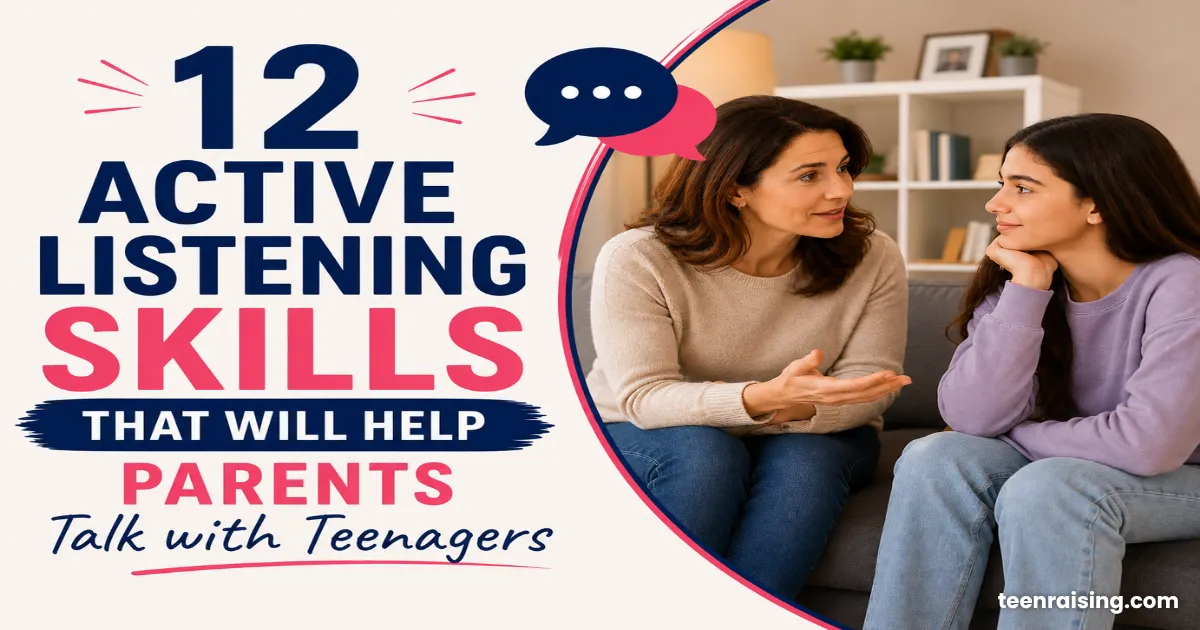

It’s true that teenagers do not stop talking but only when they feel that they are unheard. When trying to figure out how to listen to your teenager without making everything a fight, know that developing active listening skills for parents can be one of the best things you can do.
Unlike jumping into giving your opinion and advice, active listening skills for parents will allow you to learn about your teenager’s mindset, feelings, and problems. Such a shift in approach will help you communicate better with teenagers, build better communication skills for parents, and foster open communication with teens.
As per research conducted by the Centers for Disease Control and Prevention (CDC) and American Psychological Association (APA), effective communication between parents and teenagers fosters positive mental health, emotional resilience, and better decision-making abilities. Below are the 12 listening skills that will assist you in building up healthy relations with your teenager.
Importance of Active Listening Skills for Parents
There are numerous emotional, social and academic changes in the lives of teenagers. Although they appear to be self-sufficient, teenagers also need grown-ups who will listen to them. Active listening skills training for parents allows for establishing an environment where teenagers are being treated with respect.
What the Research Says
| Study | Key Conclusion |
| CDC – Positive Parenting | Good communication leads to less risky behavior and contributes to the overall well-being of teenagers. |
| APA – Family Communication | A teenager who feels listened to is more likely to have trust in their parents during challenging times. |
This research emphasizes the importance of active listening parenting not just in hearing what teenagers say but in developing trust between parents and teens.
Also read: Questions That Get Teens Talking and Strengthen Your Connection
1. Give Your Teen All Your Attention
In order to develop active listening skills in parents, one thing that could be done is that we must eliminate any possible distractions. We should put our cell phone aside and switch off the television and concentrate fully on the teenager.
It would not only be appreciated by the teenager but also make him/her feel that he/she has full attention from the parent.
Rather than questioning them while you’re on your phone, try saying the following:
“I’m listening. Tell me what’s on your mind.”
This small change can dramatically improve better communication with teenagers over time.
2. Listen to Understand, Not to Respond
One of the best ways for parents to practice active listening is by avoiding the need to come up with a response while the adolescent is speaking.
Ask yourself:
“What emotion is the adolescent trying to convey?”
Listening without being critical allows parents to pick up on things they may not otherwise notice.
Real-Life Experience
Jennifer is the mother of a 15-year-old from Ohio who has been noticeably quieter after school lately. Each time her daughter came home from school, Jennifer would come up with solutions without knowing the whole story.
One night, she did something else. Rather than telling her “It’ll be okay,” she just listened.
She finally confessed after a few minutes of silence that she felt left out by her clique of friends.
As Jennifer revealed afterward, “She didn’t need guidance first; she just needed someone to listen.”
This was the start of honest conversations with their teens within their household.
The experiences of Jennifer teach us that how to listen so your teenager will talk.
3. Ask Open-Ended Questions
For parents who wonder how to be better listeners, it’s time to ask more open-ended questions instead of those seeking one-word answers.
In place of:
“Was school fine?”
Ask:
- “What was the best thing about your day?”
- “What made today difficult?”
- “How do you feel about that?”
Open-ended questions help enhance parent listening skills since they require the teenager to answer by sharing his/her thoughts rather than providing simple answers.
This is one of the easiest active listening techniques for parents to use on a daily basis.
4. Reflection before Advising
One of the best techniques of active listening that parents can use to support teenagers in their feelings is reflection.
For instance:
Teen: “Nobody wanted me on their project.”
Instead of: “Don’t worry about it.”
Use: “That sounds disappointing. I can understand why you’re upset.”
It shows genuine empathy in parenting as well as builds trust between parents and teens.
After the emotional reaction, parents can discuss ways out of the situation.
5. Embrace Empathy Over Criticism
Teens are reluctant to reveal themselves out of fear of being judged.
Empathic parenting implies that instead of judging what is right or wrong at first sight, one should try and get inside the shoes of their teen.
Instead of saying,
“You are overreacting.”
Say,
“Tell me why it is so important for you.”
Such parents will inevitably become better communicators.
Also read: Parent-Teen Communication: 15 Proven Ways to Build Stronger Relationships
6. Establish Everyday Listening Routines
Good relationships aren’t formed in one grand conversation; they’re formed through consistent everyday engagement.
Establishing daily active listening habits for parents doesn’t take any additional time
Examples of such listening routines are as follows:
- A meal without a device every day.
- One good question a day.
- Two minutes of uninterrupted listening.
- An everyday emotional connection.
7. Mind Your Teen’s Non-Verbal Language
At times, what teenagers are not saying is more powerful than anything else. Any change in their facial expressions, body movements, tone of voice, or even routine could be an indication of how they feel.
However, one of the least utilized active listening tips for parents would be to watch out for these non-verbal signs and not to jump into conclusions. Instead of asking your teen what might be going on, just let them know you have observed what was happening with them.
For instance,
“Seems like you were quiet this week. I am always around when you are ready to chat.”
This way, you can establish trust with your teens and foster healthy parent-child relationship between them.
8. Validate Feelings Before Problem-solving
While parents usually have an urge to solve problems, teenagers sometimes require validation before getting a solution to their problem.
Validation involves accepting your teenager’s emotions, regardless of whether you agree with all the decisions he or she has made.
Avoid phrases like:
“This is nothing.”
Go for statements like:
“I can see why this upset you.”
In addition, validating your teenager’s feelings demonstrates empathy as a parenting strategy and active listening as a parenting technique.
When emotions are validated first, advice is much more likely to be accepted.
9. Do Not Make Every Conversation a Lecture
Making each discussion a life lesson becomes a major obstacle to effective interaction with adolescents.
When each discussion turns out to be a lecture, adolescents stop talking.
Ask yourself this question:
“Are they in need of some advice, or all they need from me is to listen?”
The process of learning how parents can become better listeners involves being able not to take control of the conversation.
10. Do Active Listening Exercises
Similar to other skills, listening is enhanced through practice. Active listening exercises practiced by parents enable positive communication to become part of one’s daily routine.
Below are three easy active listening exercises for parents:
Exercise #1: Two Minutes of Listening
Listen to your teenage child talk for two minutes without interrupting her.
Exercise #2: Reflect and Clarify
Reflect on what your teen just told you before expressing your thoughts.
Example:
“Are you saying that you are stressed about having two exams on the same day?”
Exercise 3: Ask One More Question
Rather than giving advice and closing the discussion, ask:
“Is there anything else you would like me to know?”
These exercises develop communication skills for parents and teaches how to listen so your teenager will talk.
Also read: Why Teens Stop Talking to Their Parents: Understanding the Silence and Rebuilding Trust
11. Follow Up After Significant Discussions
Listening does not stop once the discussion ends.
When your teen opens up to you about something that means a lot, discuss it again the next day or two.
For instance:
“I have been reflecting on what you said to me the other day. How do you feel right now?”
By doing this, it reflects the fact that you really care about them and also builds the trust of parent-teen relationships. This is also an easy active listening techniques for parents.
Parents who constantly follow up always see remarkable progress in improved communication with teens.
12. Patience and Consistency
Developing trust isn’t going to take place in one day.
There might be times when your teen hardly says anything even though you have mastered great listening skills.
It all lies in being consistent.
Keep practicing active listening skills for parents and create opportunities for connection without pressure.
Your teen will realize in time that you are a person who he/she can count on not only in good times, but also in tough ones.
This is how your conversation becomes a lifelong relationship.
Do vs. Don’t: Active Listening as Parenting Technique
| Instead of This… | Try This Instead… |
| Interrupting your teen | Let them speak out entirely. |
| Immediately giving out your advice | Ask questions for better understanding. |
| Saying, “You’re overreacting.” | Say, “I can understand why you feel that way.” |
| Comparing them to siblings or yourself | Pay attention to your teen’s experience alone. |
| Staring at your mobile phone during their conversation | Attend and make eye contact with them. |
These small modifications will help you enhance active listening parenting skills and make it simpler to learn how to listen to your teenager on a daily basis.
Listening Today, Connecting for Life
Establishing good relationships with adolescents requires that one first be an improved listener. Through practicing active listening skills for parents, applying active listening techniques for parents, and practicing empathy in parenting, one is able to establish communication with the adolescent and build trust between parent and teens. Note that learning to listen to your teenager does not mean that you have all the solutions but that you have understood what is going on.