

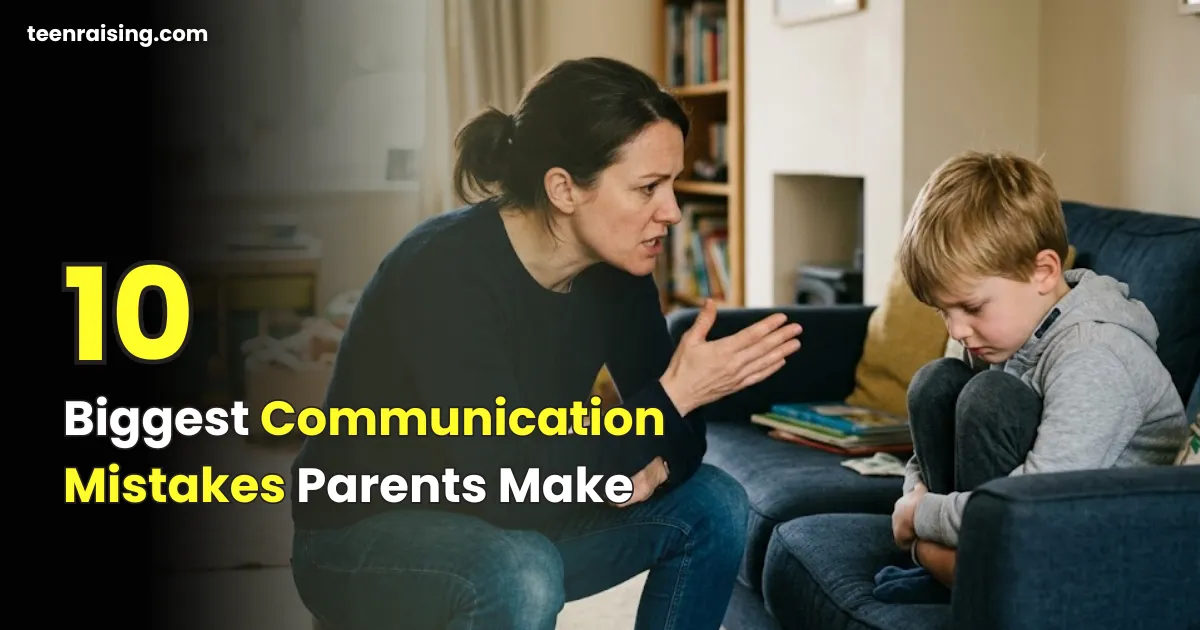

Parenting a teenager can be quite confusing for parents, particularly when natural conversations turn out to be silent, arguments, or one-word answers.
What needs to be known is that it is not usually intentional that parents hurt communication in the process. They actually talk out of care and love. However, when parents commit the worst of their mistakes regarding communication, they do so without being aware of what they are doing.
Learning how to overcome these biggest communication mistakes parents make will allow you to rebuild that connection with your teenager before it is lost for good. What is the bright side? All the mistakes mentioned in the article can be changed.
This resource shows how parents accidentally push teens away. It gives suggestions to avoid making the same mistakes and to behave in a better way. This guide also enlightens you with the ways parents hurt communication without realizing it.
The Importance of Parent-Teen Communication
The American Academy of Pediatrics states that effective communication fosters emotional safety, contributes to mental health, and encourages adolescents to ask for help when necessary.
This finding is also supported by research which indicates that adolescents who have an emotional bond with their parents tend to engage less in risk-taking behaviors and behave in a way that leads to their development of appropriate coping skills.
There is no need for communication to be flawless; it just has to be secure, courteous, and reliable.
Also read: Parent-Teen Communication: 15 Proven Ways to Build Stronger Relationships
Quick Overview: The 10 Biggest Communication Mistakes Parents Make
| Communication Mistake | Possible Impact on Teen | Better Alternative |
| Interrupting | Feels unheard | Listen completely |
| Lecturing | Shuts down conversation | Ask open-ended questions |
| Constant criticism | Lowers self-esteem | Focus on encouragement |
| Dismissing feelings | Emotional withdrawal | Validate emotions |
| Comparing with others | Creates resentment | Celebrate individuality |
| Solving every problem | Reduces confidence | Guide instead of fixing |
| Talking only about mistakes | Avoids conversations | Notice positives too |
| Overreacting | Encourages secrecy | Respond calmly |
| Poor timing | Defensive responses | Choose calm moments |
| Ignoring your own communication | Damages trust | Model respectful behavior |
1. Cutting In Before Their Statement Is Complete
One of the biggest communication mistakes parents make while talking to their teenagers is that they think they already know what their teenagers are talking about and cut them off. Sorry to say, interruptions communicate to teens:
- “My viewpoint is more important.”
- “You have nothing to say.”
- “It’s pointless to talk.”
As time goes by, this is one of the serious parent teen communication problems.
Rather
Listen well.
Wait until your teen has finished speaking before you respond.
Basic expressions such as:
- “Go on.”
- “I’m all ears.”
- “And then what happened?”
Promote more in-depth conversations.
2. Turning All Conversation into a Lecture
So many parents really do want to teach life lessons.
Yet long speeches tend to be one of the most common mistakes when talking to teenagers.
Teens usually stop hearing after the first minute if they feel they’re being preached to.
See this alternative
Trade lectures for curiosity.
Instead of:
This did not work.
You might try:
What do you think could have been done differently, then?
Questions get you thinking.
Lectures breed resistance.
Real life example:
A mother found that when her 15-year-old son got home from school, he would stop talking.
Instead of asking dozens of questions every afternoon she just said,
“I’m here any time you want to talk.”
Nothing for nearly a week.
At one dinner, he, spoke of his trouble making friends.
It was a nearly hour-long conversation—not because she insisted, but because she fostered emotional safety.
Silence is not rejection sometimes.
It is your teenager who has to feel safe.
3. Correcting Every Little Mistake
Teenagers already receive corrections from teachers, coaches, and peers.
If parents only point out mistakes, home no longer feels emotionally safe.
This becomes one of the communication habits parents should avoid because constant correction often leads teens to avoid conversations altogether.
Instead, notice effort.
Say things like:
- “I appreciate you helping.”
- “Thanks for telling me.”
- “I know you’re trying.”
Positive reinforcement builds a relationship.
4. Invalidating Their Feelings
Minimizing emotions is one of the biggest communication errors parents should avoid.
Such statements as:
- “You are exaggerating.”
- “No big deal.”
- “You’ll get over it.”
May seem harmless, but can leave teenagers feeling misunderstood.
These are examples of what not to say to your teenager, especially when they’re emotionally vulnerable.
Say rather:
“That is so hard”
Validation is not agreeing.
It’s about feeling.
5. Comparing them to other children
Comparisons seldom inspire.
Rather they breed insecurity and resentment.
For example:
- “Your cousin makes all A’s.
- “Why can’t you be more like your sister, responsible?”
This is one of the classic parent child communication mistakes that quietly damages self-confidence.
Don’t compare your teen to someone else.
Signs Communication May Be Breaking Down
| Teen Behavior | Possible Meaning |
| One-word answers | Doesn’t feel heard |
| Avoids conversations | Fear of criticism |
| Spends more time alone | Emotional withdrawal |
| Gets defensive quickly | Expects judgment |
| Shares more with friends | Doesn’t feel safe talking at home |
6. Trying to Fix Everything
Parents want to make things right.
But teens also need opportunities to develop resilience.
Offering solutions immediately is one way parents push teens away by accident, especially if they just wanted someone to listen.
Instead say:
- “Some advice?
- “Or you want me to hear?”
That one question can totally change the conversation.
Also read: How to Talk to Your Teen Without Arguments: 10 Proven Communication Strategies for Parents
7. Communicating Only When Things Go Wrong
Communication within many families occurs only during times of conflict.
- When it comes to schoolwork.
- Curfew.
- Grades.
- Screens.
- House assignments.
Soon enough, teenagers learn that conversations occur only to make complaints.
This has probably been one of the most neglected communication mistakes with teenagers.
Engage in conversations at the everyday situations
- While driving together
- Taking a walk with the dog
- While shopping for groceries
- While cooking dinner
Casual conversation becomes more meaningful.
8. Overreacting
Picture this:
The teenager in your house has just admitted to making a mistake.
If your response is to get angry, punish, or freak out, your teenager may never be honest again.
This is one of the biggest communication mistakes parents make in communicating with teenagers. Instead of teaching children how to deal with their mistakes and issues, parents are teaching them how to hide them.
Take a moment and think about your response before acting.
- Respond first.
- Discipline later.
9. Choosing the Wrong Time
Timing matters more than many parents think.
Discussing difficult topics while your teenager:
- is just waking up,
- is in a rush to and from school,
- is tired,
- or is upset, generally ends in failure.
Choosing peaceful times solves many parent teen communication problems before they begin.
10. Forgetting the Concept of Actions Speak Louder than Words
Often, parents are the ones telling their children to speak respectfully while shouting or interrupting him themselves.
Kids are more influenced by actions than by advice.
Let them be a role model for their own behavior.
Respect generates respect.
Listening encourages listening.
This is one of the most common communication pitfalls of the parents and at the same time easily avoidable through self-awareness.
How do communication mistakes affect teenagers?
The important question that many parents ponder over is, ” How do communication mistakes affect teenagers?”
The impact might not be felt at once, but it builds over time and can be hard-hitting.
| Communication Mistake | Possible Long-Term Effect |
| Constant criticism | Lower confidence |
| Dismissed feelings | Emotional suppression |
| Frequent lectures | Reduced openness |
| Comparisons | Anxiety and self-doubt |
| Overreacting | Increased secrecy |
| Lack of listening | Weak parent-child trust |
Good communication can’t prevent conflicts from showing up.
But it provides a secure environment to solve those problems together.
Small Modifications that Contribute to Stronger Relationships
Instead of aiming at becoming an ideal parent, strive to become a better listener.
Implement these best practices this week:
- Listen and do not interrupt.
- Acknowledge the feelings of your child before giving him/her any advice.
- Try to ask more questions than to provide answers.
- Spend at least 10–15 minutes talking daily with your child without touching upon either school or chores.
- Notice one positive thing your teenager does every day.
These simple practices are good for avoiding misunderstandings with teenagers and establishing trust between you.
Expert’s View
According to the Child Mind Institute, it is advisable to listen rather than attempt to offer solutions because teens wish to be understood before being given advice. In addition, HealthyChildren.org (American Academy of Pediatrics) indicates that parents should remain calm, acknowledge the feelings of their children, and continue communicating with their teens even when there is disagreement. These strategies allow an atmosphere of emotional safety which fosters sustainable trust between parents and their children.
In conclusion, Connection is More Important than Perfection.
All parents make mistakes; the key is recognizing them as well as making small adjustments.
The major and biggest communication mistakes parents make is that they do not have to do with lack of love, but rather with stress and anxiety as well as the desire to protect. By realizing these patterns, parents can substitute frustration with understanding and establish a relationship in which their teenagers are able to communicate.
Strong communication does not just come through one conversation. Instead, it arises from numerous small instances of listening and demonstrating empathy, and respect. Over time, steering clear of the most significant mistakes with communication that parents make can allow for a deeper sense of relationship.
Related Articles:
Why Teens Stop Talking to Their Parents: Understanding the Silence and Rebuilding Trust
Questions That Get Teens Talking and Strengthen Your Connection
12 Active Listening Skills That Will Help Parents Talk with Teenagers