

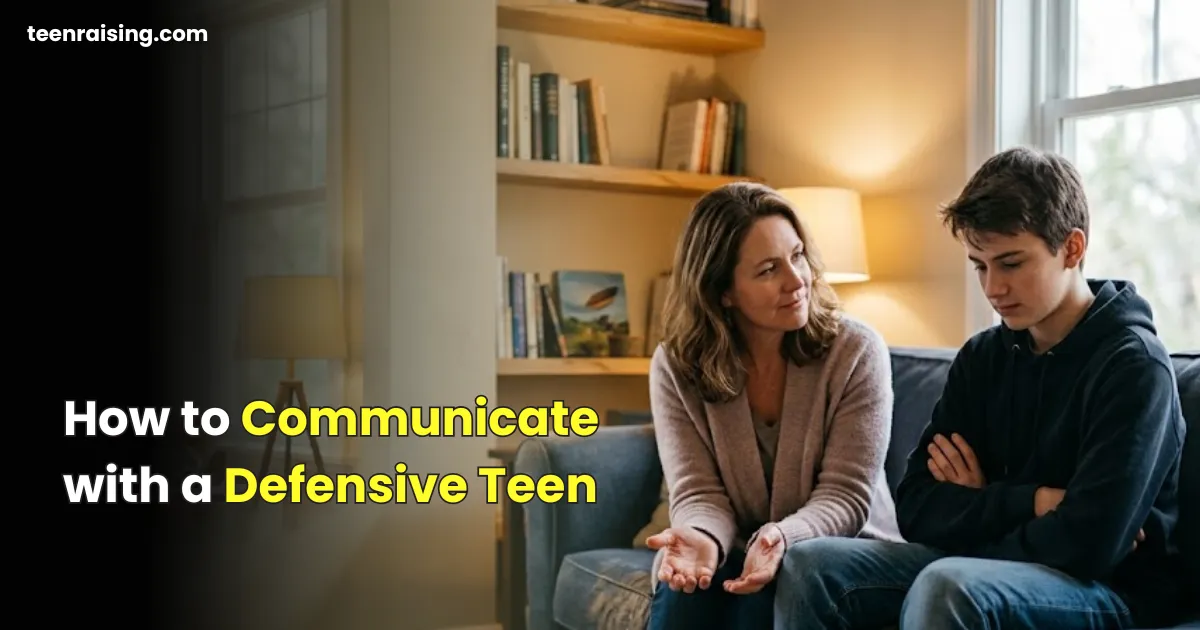

When your teenager answers your question with “Why are you always bugging me with such questions?” or quickly retorts with “I didn’t do anything!”, you may ask yourself, “Why is my teenager so defensive when I talk to them?”
You’re definitely not alone.
It’s quite common for a teenager to be defensive, particularly when feeling judged, controlled, ashamed, misunderstood, or just generally overwhelmed. Teenage years bring many significant changes, including independence, emotional development, relationships, and decision-making. However, this doesn’t mean that parents should tolerate disrespectful behavior, although it might be important how we begin our dialogue.
Defensive Teen Communication Tips Are Not About Finding the Right Words. They Are About Creating Enough Safety So Your Teen Can Listen—and Ultimately Talk.
The American Academy of Pediatrics says parents should listen without being judgmental, avoid lecturing, and create a safe environment for teens to voice their worries. (HealthyChildren.org)
These are 12 effective tips that may help.
Why Is My Teenager So Defensive When I Talk to Them?
Understanding why your teen may act this way is necessary before you change how you converse with him.
Teens are becoming more independent while learning to handle their intense emotions. Your teenage child may also misinterpret your questions as accusations without any intention of you doing so.
Example:
Parent: “Have you done your homework?”
Teen: “Yes, I know! Don’t treat me like a child.”
Perhaps the parent was just making sure. The teen might think, “You don’t trust me to manage my own things.”
It is here that understanding teenage behavior comes into play. Defensiveness doesn’t necessarily imply that your teen is lying or deliberately being naughty.
Also read: How to Handle Difficult Conversations With Teens Without Causing Arguments
12 Proven Strategies for Defensive Teen Communication
1. Begin with Curiosity Rather Than Blame
One of the best ways to talk to a defensive teenager would be to change blame with curiosity.
For example, instead of asking:
“Why are you so irresponsible?”
It is better to ask:
“I noticed that you have been having trouble starting your homework. Why do you think it is difficult for you?”
This way, your teenager gets a chance to explain himself/herself.
2. Listen Before Offering Help
Parents often feel like they have to fix things. However, sometimes all that teenagers need is to be heard.
According to the American Academy of Pediatrics, listening may be more important than trying to know what needs to be said. (HealthyChildren.org)
It could be useful to ask:
- “Do you need my help or just my ear?”
- “What happened?”
- “What should I do?”
This little trick will make effective communication with teenagers easier.
3. Stay Calm
The teenage child’s defensive tone may quickly provoke frustration in you as a parent.
However, when you get agitated since the child got agitated first, the whole discussion may be turned into a battle.
This advice is especially critical concerning the emotional regulation in teens. As teens have not learned yet how to control strong feelings, parents can be a good example of that in their behavior. (Child Mind Institute)
Sometimes the best reaction is simply:
“We’re both frustrated. Let’s take a break and talk about this later.”
This does not mean giving up. It means preventing things from escalating.
4. Not Everything Is Personal
Your adolescent might slam a door, give you an eye roll, and tell you to “leave me alone!”
It will sting, especially after putting all your efforts into it.
However, not everything that your teen does emotionally is truly personal to you.
There is an increase in independence that comes with adolescence. (American Psychological Association)
Before saying, “I am no longer respected by my child,” ask yourself:
“How would my adolescent be feeling right now?”
This question will completely alter your response.
5. The No Lecture Rule
Not much makes a defensive teenager more defensive than a 20-minute lecture.
You may have some advice worth hearing, but the adolescent will tune out your voice shortly into your lecture.
As mentioned earlier, the AAP explicitly recommends against giving teenagers lectures since adolescents under stress are not able to take in lengthy abstract lectures. (HealthyChildren.org)
Keep it short and simple.
Instead of:
“When I was your age, I never spoke to my parents like this…”
Say:
“I know you’re upset, but disrespecting me won’t be tolerated. We’ll talk later.”
6. Validation Without Agreement
Validation doesn’t imply agreeing with all your teen’s views.
The key is accepting that they do feel that way.
For instance,
“I know why you’re upset.”
You could follow up with,
“But we have to work it out.”
This technique comes in handy when trying to learn how to respond to a defensive teen.
Valid communication helps you validate your teen’s feelings without compromising on healthy boundaries.
Also read: 10 Biggest Communication Mistakes Parents Make (and What to Do Instead)
7. Find the Appropriate Time
Parents underestimate the importance of timing.
Discussing the missing homework right after your teenager arrives home tired from school will not be the most effective way to engage in conversation.
According to the AAP, you should pick the right times and places for the communication, as well as give kids the time to unwind. (HealthyChildren.org)
Some parents find that having a conversation on the way to school, in the kitchen cooking, or walking a dog is a lot easier than talking at the kitchen table.
8. Use “I” Statements Instead of “You” Statements
“You never listen.”
“You always argue.”
“You don’t care about anything.”
They can make teens feel like you’re attacking them.
Instead use:
“I am concerned when I don’t know where you are.”
Or:
“I am frustrated with how I feel whenever we have a conversation that ends up in an argument.”
Utilizing the “I” statement technique takes the focus off of your teenager.
It is perhaps the easiest way to keep your argument with a defensive teenager from escalating.
9. Give Control to Your Teen
Teenagers are on their way to becoming adults. If you keep instructing them about everything, they may become powerless.
If possible, provide them with choices that are sensible.
Instead of:
“Turn off your phone immediately.”
You could say:
“Would you like to continue this discussion right away or would you prefer to talk after dinner?”
This will give them the sense of both autonomy and connection, which is an essential part of healthy adolescence. (American Psychological Association)
10. Know What to Say to a Defensive Teen
Some parents know they have to stay calm, but they just don’t know what to say to a defensive teenager.
Remember some phrases:
If they are shutting down,
“You don’t have to talk now; I’ll be here when you are ready.”
If they get angry,
“I want to understand you, but let’s talk about it when we are both calmers.”
When they say you don’t get it:
“Maybe I’m still not getting it. Help me see it from where you’re standing.”
When you messed up:
“I messed that up really bad. I’m sorry.”
The last one is often incredibly powerful. Your parents won’t lose their authority when they admit to making a mistake.
11. Connect First, Correct Later
When everything you do with your teen involves grades, household tasks, screen time, curfew, or behavior, they might start linking chats with reprimands.
Give them a chance to connect.
Ask them about their favorite TV show. Share memes with them. Go for ice cream. Sit with them and play a game.
According to the AAP, just minutes of undistracted attention can help with family communication. (HealthyChildren.org)
Building trust with a defensive teenager takes many interactions—not just one great conversation.
12. Knowing When Defensiveness Could Indicate an Underlying Issue
Some amount of defensiveness can be normal during development, but a change that seems abrupt or excessive should not be ignored.
Look for other symptoms like:
- Substantial withdrawal from family members or peers
- Severe shifts in sleep patterns or eating habits
- Lack of enjoyment in previously cherished hobbies
- A marked feeling of depression or irritability
- Decline in school performance
- Behavioral extremes
Child Mind Institute advises that one should notice important changes in functioning and seek help if the issues become persistent. (Child Mind Institute)
In case you are worried about the emotional or psychological well-being of your teenager, it would be advisable to consult their pediatrician or a psychologist.
Also read: Why Teens Stop Talking to Their Parents: Understanding the Silence and Rebuilding Trust
A Familiar Incident That Many Parents Can Relate To
One working mother recounted an episode that is all too common for parents.
She came back from school, put down her backpack and went straight to her bedroom. Her mother came after and asked, “What’s the matter?”
“Nothing.”
“Really?”
“Yes! Now can you just leave me alone?”
Her mother was annoyed because her immediate reaction was to keep on asking questions.
But she stopped and said:
“Okay, no pressure from me. I’m cooking pasta. When you’re ready to talk, I’m here.”
Approximately half an hour later, her daughter came into the kitchen.
She had gotten a bad grade and felt ashamed because her friends did better than her.
There had been no magic involved. The mother just didn’t keep pushing until her daughter felt comfortable approaching her.
This is what Defensive Teen Communication actually looks like. Not all you have to do is make your teen tell you things straight away. Sometimes, that’s not the point at all.
How to Stop Arguments with a Defensive Teen
Well-meaning parents might even unintentionally make things worse.
Don’t:
| Rather than… | Use… |
| “You always do this.” | “Let’s discuss what went on.” |
| “Because I said so!” | “It is important because…” |
| “Don’t be so dramatic.” | “I know that you must be very upset about this.” |
| “You’ll understand when you’re older.” | “What’s your perspective on it?” |
| Long lectures | Conversations that get straight to the point |
| Punishments right away | Understand first what happened |
| Interrogating | Asking open-ended questions |
Good communication doesn’t necessarily have to eliminate boundaries. Instead, what is needed is respectful communication of the boundaries.
The Idea Is Not Having a Perfect Teen – It’s Building a Good Relationship
Getting to know how to communicate with your teen in defense mode requires some time. Eye-rolling and slammed doors are still going to happen.
This is natural.
The ultimate aim is to develop a connection wherein your teenager feels that,
“My parent might not agree with me, but I can speak to them.”
This forms the very essence of building trust with a defensive teenager.
Teenage emotional development and maturity is a process which requires patience on part of the parents. By listening patiently, staying calm, respecting growing independence, and maintaining healthy boundaries, parents provide their teenagers with something really important – a place to go back to when the going gets tough.
Sometimes, it’s not about winning the argument.
It’s about making sure that your teenager comes back tomorrow.
Also read:
How to Talk About Sensitive Topics with Teenagers Without Conflict
12 Active Listening Skills That Will Help Parents Talk with Teenagers
How to Talk to Your Teen Without Arguments: 10 Proven Communication Strategies for Parents
Parent-Teen Communication: 15 Proven Ways to Build Stronger Relationships
Questions That Get Teens Talking and Strengthen Your Connection