

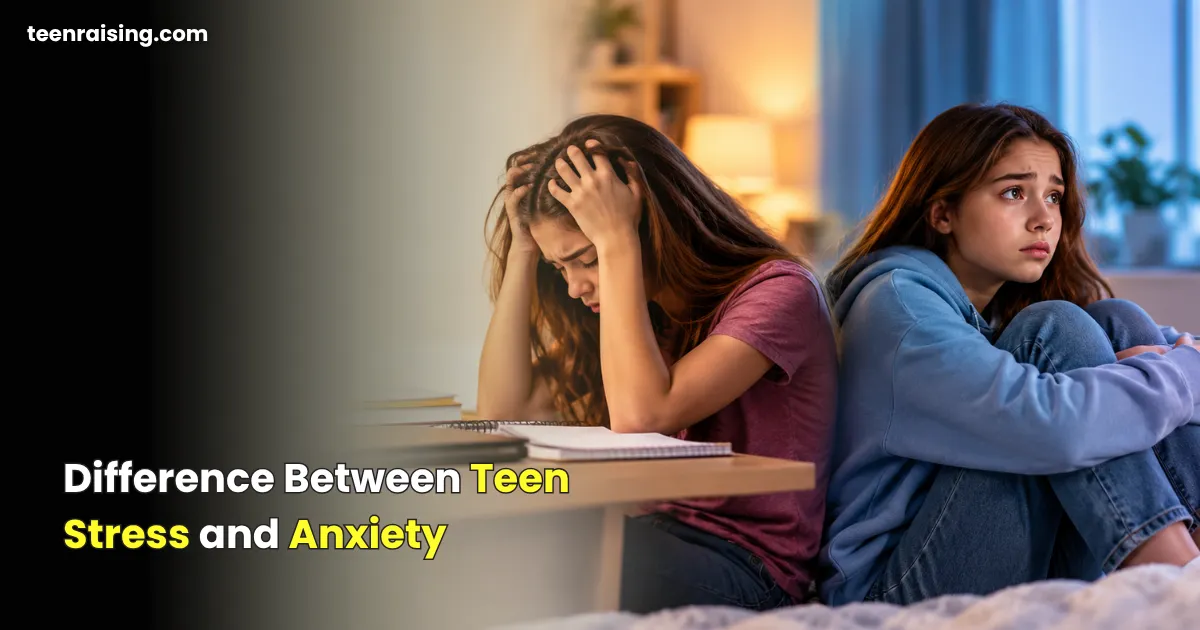

There are many stresses that teenagers go through while growing up during their adolescent phase. Be it studies, examinations, peer pressures, social media pressures, family pressures, or thoughts for the future; adolescents experience stress sometimes.
It is necessary to state here that anxiety is not always the same as stress. The cause of stress may be some challenge that an individual faces, whereas there is no need for any challenge at all in case of anxiety.
Being able to understand the difference between teen stress and anxiety may help the parent better respond to the situation at hand.
The aim of this guide is to explain the various symptoms, causes, and the difference between stress and anxiety in teenagers. The guide also shows parents how they can help their children without being judgmental.
What Is Stress in Teenagers?
Stress in adolescents means the body and mind’s response to stress and tough situations. Stress in adolescents happens when an adolescent is unable to cope with the amount of work they have to do.
For instance, a teenager could be stressed over an examination in math, an oral presentation in school, a dispute with friends, or a deadline for college admission. These could intensify as the event gets closer.
Stress is often relieved once the issue is solved, or once the teenager masters managing the stress.
Common Causes of Stress in Teens
Several everyday situations can contribute to stress in teenagers.
- Academic stressors: Stress regarding exams, homework, grades, or any other stress due to getting ready for college.
- Issues with friends: Problems with peers, peer pressure, bullying, or social rejection may all be sources of stress.
- Family stress: Family-related stress results from the feeling of needing to meet certain expectations.
- Social media: Stress from comparing yourself to others or because of comments online.
- Active social life: Stress from trying to juggle your studies with other activities and even employment.
- Transitions: Stress from changing schools, living arrangements, or families.
Not all kinds of stress are bad. Some amount of stress is good since it helps you accomplish certain tasks. However, if there is too much of it, it may affect your sleep, mood, concentration, and social life.
It is necessary to know how to tell that your child cannot cope with stress.
What Is Anxiety in Teens?
Anxiety is a mental condition characterized by concerns, apprehensions, and fear regarding future events. It is normal for teenagers to feel anxious prior to an examination, competition, or even a simple discussion.
What makes the issue even more severe is when the anxiety is uncontrollable, occurs often, and disrupts one’s daily routine.
Whereas stress is commonly associated with a specific challenge, anxiety can still persist even after the situation has subsided. For instance, a teenage student may have completed an examination, but he or she may be anxious about performing poorly, let down their parents, or even make future mistakes.
Physical symptoms of anxiety include palpitations, muscle aches, headaches, or stomach pains.
Based on NIMH, anxiety disorder is not simply about feeling anxious at times. The symptoms may become persistent, more severe, and get in the way of everyday tasks.
It should be pointed out by parents that just because the child feels anxiety does not necessarily imply that he or she suffers from anxiety disorder.
Causes of Anxiety in Teenagers
Knowledge of the reasons for teen anxiety can help parents better understand what may be bothering their teenagers. Anxiety may not necessarily have a single identifiable reason but may instead result from a combination of factors.
Some common factors that may contribute to anxiety in teens include:
- Academic stress: Being afraid of poor academic performance or failing in exams.
- Social problems: The fear of being rejected, facing social problems or being bullied.
- Social media: Pressure from comparison or being judged on social networking sites.
- Family problems: Divorce or any other problem in the family.
- The fear of failure: The feeling of not meeting the expectations.
- Biological or personal issues: Personal characteristics and family history might have an impact on the development of anxiety.
For instance, one adolescent could be stressing about an approaching presentation while another one may still have the fear of failing despite getting decent grades.
Remember that anxiety is not a result of weakness or poor parenting. Instead of assuming your child is just exaggerating, you need to determine the cause of his anxiety and its effect on his everyday activities.
Experiencing stress may be a factor contributing to the development of anxiety, but not all stressed teenagers suffer from anxiety disorders.
Teen Stress vs Anxiety: What Is the Difference?
It is difficult to understand stress and anxiety in adolescents since the two disorders exhibit similar symptoms. Some of these symptoms include irritability, sleep difficulties, headaches, and lack of concentration.
The key difference is with regard to timing and the period in which the emotions last. Stress is typically linked to some particular cause, such as a forthcoming exam or an argument with a friend. Anxiety, on the other hand, may continue after the particular issue has already been sorted out, or it may have several causes.
The following table will help parents to know the difference between teen stress and anxiety.
| Factor | Teen Stress | Anxiety in Teens |
| Common trigger | Often linked to a specific problem or demand | Can include fear or concerns about certain situations |
| Duration | May improve when the stressful situation ends | Can persist even after the situation is resolved |
| Main feeling | Feeling pressured, overwhelmed, or frustrated | Feelings of worry, fear, restlessness, inability to relax |
| Common thoughts | “I have too much homework to finish.” | “Even though I study, what if I fail?” |
| Physical symptoms | Tiredness, headaches, and muscle tension | Heart palpitations, nausea, insomnia, and muscle tension |
| Effect on daily life | May make a busy period harder to manage | May result in repetitive avoidances or problems with daily activities.” |
| Helpful support | Problem-solving, rest, and time management | Stress management techniques and, if necessary, psychological intervention |
Such distinctions are not universal; they represent only typical cases, because stress and anxiety may often overlap.
A Simple Example for Parents
Let’s think about how your teen has a very crucial school presentation coming up on Friday.
Now, on Monday, he or she becomes worried because he or she is not ready for the presentation. He or she works harder to practice, gets assistance from the teacher, and feels great after the presentation is done.
Now suppose that your teenager studies hard but goes on to be anxious for days on end. They are afraid that their fellow students will laugh at them, can’t sleep due to worrying about making mistakes, and start avoiding making presentations in the future.
It would appear that in this second example, anxiety has a greater role to play.
Should such behavior persist or interfere with school, friends, or sleep, you might want to seek advice from your teen’s pediatrician or a psychological counselor.
How to Tell If a Teen Has Stress or Anxiety
How do you differentiate between stress and anxiety among teenagers where both appear to have similar symptoms? Firstly, one will find out what is the cause of these feelings, whether the feelings go away once the problem is solved, and how they affect the teenager’s day-to-day functioning.
Three important questions to think about include the following:
1. Is there a specific trigger?
When stress occurs, it is usually caused by some kind of situation, like taking a test, having a particularly difficult week, or even having an argument. Anxiety may be caused by a continued concern or multiple concerns.
2. Is the worrying relieved?
It is important to note whether the teen is feeling better after the issue or if he is still experiencing distress.
3. Is there an impact on daily living?
When you find that your teenager is facing trouble with sleep, absence from school, withdrawal from socialization, and inability to perform normal activities, then it would be a good idea for you to observe.
These kinds of questions will help you understand the situation of your teenager, but they cannot diagnose any anxiety disorders.
What Are the Signs of Stress in Teenagers?
Teenagers may experience stress through various feelings, behavior, and physically. Some teenagers might freely talk about their problems, but others will usually keep quiet or become irritable.
Teen Stress Symptoms include:
- Becoming frustrated because of small things.
- Becoming overwhelmed by school related activities or responsibilities.
- Having difficulty concentrating on activities.
- Experiencing headaches or stomach ache while under stress.
- Sleeping fewer hours before deadlines or major assignments.
- Becoming exhausted or demotivated.
- Becoming overly emotional during exams and family arguments.
- Letting themselves have alone time after a tough day.
For example, a teenager that has multiple exams in a week can appear quite impatient right after school is over. The teenager may whine about being tired or find it difficult to organize himself.
The parents need to discover what stresses the teen out and assist the child in breaking down large tasks into smaller ones.
But then again, symptoms that persist can’t just be attributed to stress; other issues may have to be taken into account.
What Are the Signs of Anxiety in Teens?
Anxiety symptoms in teenagers manifest themselves emotionally, physically, and behaviorally. Adolescents realize that they are worrying excessively and that they cannot stop doing so. Adolescents focus on their physical symptoms while ignoring the fact that worry may have brought about those symptoms.
Patterns can include:
- Concentrated worry regarding school, friends, family, or the future.
- Always expecting something negative to take place.
- Not being able to relax, even during leisure activities.
- Concentrating on obtaining reassurances regarding specific worries.
- Avoidance of school, social interactions, or situations that provoke fear.
- Inability to fall asleep due to worrisome thoughts.
- Palpitations, sweating, trembling, and stomach discomfort.
- Irritability, agitation, or problems with concentration.
Such symptoms, however, cannot be taken as a diagnosis of an anxiety disorder. Other conditions may cause physical symptoms, and consultation with a health care provider will aid in making an assessment.
The American Academy of Pediatrics has resources for parents to understand childhood and teen anxiety.
Read more: 12 Common Signs of Anxiety in Teenagers You Should Never Ignore
Stress in a Normal Teenager: When Does It Become Anxiety?
This is a frequently asked question by parents but unfortunately, there is no one symptom or a specific number of days to determine this in every single teenager.
The important thing is to focus on how frequently, intense, and affecting these symptoms are.
Ask yourself whether:
- Your teen is too worried about normal situations.
- They have trouble controlling their worries even after you reassure them.
- They are avoiding activities that they once enjoyed.
- Their sleep, academic performance, friendships, or family relations have been affected.
- Do they frequently get headaches or stomach aches?
- Are their worries keeping them from doing what they should be doing?
Should these symptoms be prevalent, it would be necessary to see a specialist.
An example is where a teenage individual is worried before taking an examination, and this may only need a bit of support together with a good study program. Another example is where the teenager shuns going to school due to anxiety, or he/she has been feeling anxious and not sleeping.
There is no need to wait until the problem becomes serious.
How Parents Can Help Teens Manage Stress and Anxiety
Understanding how parents can help teens with anxiety begins with listening and understanding what their adolescent might be going through.
Some adolescents will need help with dealing with one particular issue, while some might need help with managing some anxiety which is difficult to control.
How can parents help? By fostering healthy habits, having reasonable expectations, and providing a supportive home environment that allows teens to discuss their emotions freely.
The following are six helpful tips for parents.
1. Listen First
If there is something that needs to be addressed by the teenager, do not advise him immediately; listen to him first.
Do not tell your child, “It is nothing to worry about”; tell him, “Tell me, what is the most disturbing element for you here?”
This will ensure that your teenagers feel understood.
For example, if your teenage kid is worried about his adjustment in school, then do not talk about your own experience during your teenage days. Instead, ask him what is happening.
2. Help Them Identify the Problem
If your teen is feeling swamped, help them differentiate between what is in their control and what is not.
While they can’t necessarily change the schedule of their exams, they can make a plan for how they will study, seek guidance from a teacher, and give themselves some breaks.
In the case of anxiety, it might also help to acknowledge that their fear is about something that could happen in the future, rather than something that is happening in the moment.
3. Encourage Healthy Daily Habits
Learning how to manage teen stress is not an elaborate process. Simple actions can enable the teens to get ready for their daily struggles.
Ask your teenager to:
- Have a routine sleep pattern.
- Consume a nutritious meal.
- Do exercise.
- Take breaks while studying.
- Engage in their hobbies and socialize with friends.
- Limit screen time that hampers their sleep and other duties.
For example, when your teenager is faced with many tasks, help him/her divide the workload and take short breaks.
Inquire from your teenager about how he/she copes. Some might be helped by having a walk, while others might want to write in their journals or listen to music.
Such habits can result in good health, but constant anxiety requires professional help.
4. Do Not Add More Pressure on Children
Parents of children hope for the success of their children. But continuous reminding about good grades or achievements puts them under more pressure.
You can try placing some reasonable expectations along with rewards for results and efforts.
It could be something like, “I understand that this test is important to you. Why don’t we find a way to do this that you can handle?”
This kind of conversation communicates support without suggesting that your teen’s worth depends on their performance.
5. Teach Simple Ways to Handle Worry
Encourage your teenager to attempt deep breathing, writing in a journal, going for a short walk, or speaking to someone they trust.
If the problem seems too big to handle all at once, have them try to take one step at a time.
Do not force your teenager into an anxiety-inducing situation or belittle their feelings. When anxiety causes avoidance behavior repeatedly, a mental health specialist can design an appropriate intervention.
6. Make Communication Feel Safe
Teenagers do not want to talk about what they feel because they are afraid of getting criticized, punished, or misunderstood.
Keep the discussion peaceful especially if your teen is upset. Do not interrupt, assume, or turn their complaints into a lecture right away.
One can also inquire if they would like advice or just someone who listens.
These little steps can go a long way in making your teen more comfortable seeking help when there’s a problem.
When Should One Get Help for Anxiety in Teens?
It can be challenging to know when to seek help for teen anxiety in teens because sometimes it is just normal to have some worries. But parents need to recognize if the anxiety is persistent, intense, or interfering with daily activities.
It may be worth consulting a pediatrician or a licensed mental health care provider when your teen:
- Regularly misses school or any other engagements due to fear.
- Suffers from continuous worries that cannot be controlled.
- Is faced with sleeping issues or physical concerns.
- Displays significant change in mood, grades, friendships, or other behaviors.
- Has difficulty coping with regular situations, even with support at home.
There is no need to wait till symptoms get worse to seek assistance. The symptoms can be evaluated by a health care provider as to whether they relate to stress, anxiety, other problems, or a mixture of all these things.
Additionally, parents can consult school counselors regarding any assistance that might be needed due to academic pressures and other stresses at school.
For additional information, visit the National Institute of Mental Health’s child and adolescent mental health resources.
If your teenager starts discussing suicide or self-harm, take the issue seriously and get help immediately. In the US, dial or text 988 for the Suicide & Crisis Lifeline. If there is an imminent risk, call 911.
Final Thoughts
Understanding the difference between teen stress and anxiety will ensure that parents react to the situation with patience.
However, stress is often experienced because of a specific problem and can diminish once the problem is sorted out. The case is different with anxiety since it involves constant fear and worry that persists even after the initial threat has disappeared.
The most critical step that can be taken by parents is observation, listening without being judgmental, and being supportive without belittling how they feel.
There is no need for you to be diagnosing the issue yourself. If your teenager’s concerns are persistent and are impacting their daily lives in any way, professional help could guide you through the process.
If they have the proper help, then teenagers will be able to develop better methods for handling stress and becoming more confident as well.
Also read: Daily Habits to Reduce Teen Stress: 10 Simple Tips