

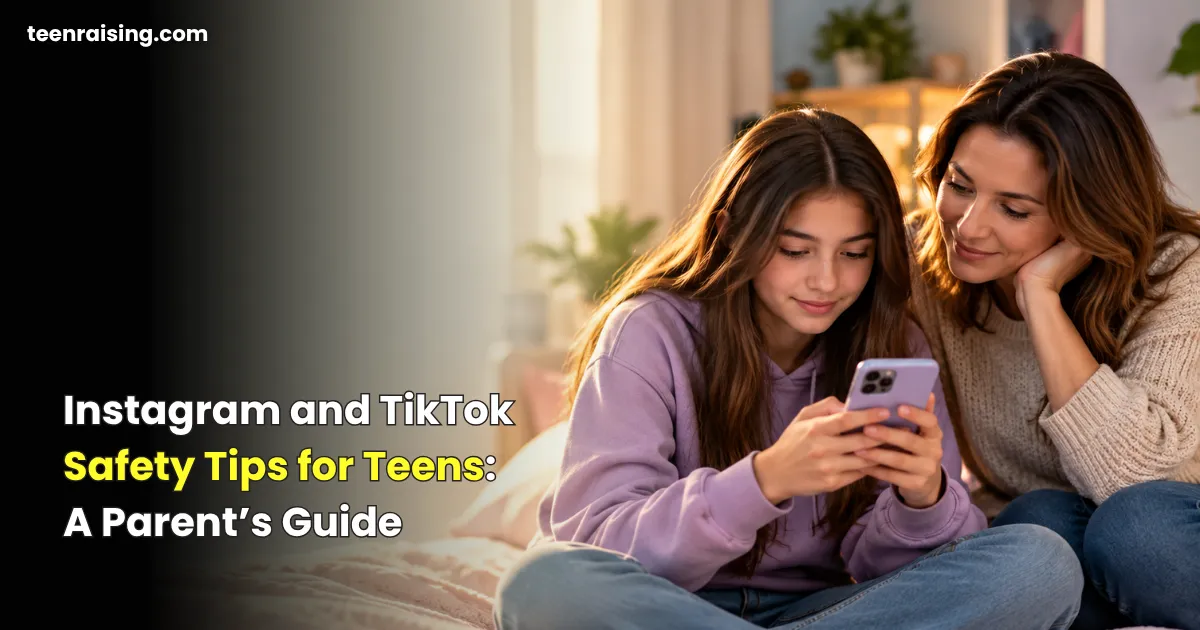

Instagram and TikTok Safety Tips for Teens have become an increasingly essential part of parenting in today’s world where social media plays an integral role in every teenager’s life. These sites allow teenagers to communicate with their friends, pursue their interests, view videos, create their content, and unwind. However, it is not always easy for parents to find a balance between giving their teenager freedom and protecting them online.
However, it doesn’t mean that it is necessary to monitor all messages or even take phones away from kids.
Parents should help teenagers learn how to protect themselves by teaching them to understand what privacy is, identify problematic situations, control who they talk to and what they do online. Instagram and TikTok have many safety tools for parents to use in that discussion as well.
Social media can be helpful to the youth as well as pose certain threats, and this point has been mentioned by the Surgeon General of the U.S., but further study on the topic is required.
Social Media Safety for Teens
To teenagers, the social media account is part and parcel of their social world. A single comment, image, private chat, or brief video can spread far beyond their immediate surroundings.
This is why social media safety for teenagers shouldn’t be limited to setting time on screens per day.
Teenagers need to know:
- Who can view their postings
- Who can contact them
- What type of personal data must remain private
- How to identify suspicious accounts
- When to block/report an individual
- Why they must think before posting anything
- Where to go if they feel uncomfortable about something online
The objective is not to scare the teens about using social media but to equip them with the necessary confidence and knowledge.
Safety Features for Teens on Instagram
Instagram has launched a number of safety features tailored to teenage users. Instagram’s Teen Accounts have features related to privacy, direct messaging, posting content and more. According to Meta, Instagram’s Teen Accounts come with a safety setting, which needs additional parental consent for modification.
But still, one should not take the safety settings for granted.
Online Safety Tips for Teens
1. Keep the Instagram Account Private
The easiest way to ensure Instagram safety tips for teens is to keep the Instagram account private whenever possible.
Having a private account allows teens to have some control over who follows them and sees their posts. The Teen Accounts on Instagram come with private options by default.
It is easy to explain this to teenagers without frightening them:
“You don’t have to let everybody on the Internet get access to your daily life.”
Teens should be encouraged to check their followers from time to time and delete unknown or untrusted ones.
2. Choose Wisely Before Sending Messages
The teenager could receive an invitation to communicate from a stranger that appears to be friendly.
Warn your teenager about taking their time to respond.
They need to be careful if anyone:
- Asks for their personal information
- Tries to take the chat to another application
- Begs them to send their pictures
- Tries to persuade them that they should keep the chat private
- Behaves aggressively when being ignored
- Says he/she is a teenager but acts strangely
The creators of Instagram have implemented additional measures regarding messaging for users of Teen Accounts.
These protections notwithstanding, teens should be able to block and report users on their own.
3. Think Before You Share Any Personal Information
The teen doesn’t have to tell everybody everything about themselves, like their school name, their address, their schedule, their telephone number, or where they are physically.
For example, taking a photo each morning outside school can share too much information.
Get your teen to ask himself:
“Would I feel good having a stranger know about this?”
If he answers “no,” then it’s probably not something he should post online.
4. Check Your Instagram Privacy Settings
The Instagram privacy settings for teens can vary due to the constant introduction of new features by the app, which makes reviewing them from time to time beneficial.
These may include:
- Account Privacy
- Settings for Messaging
- Comment Settings
- Settings for Tagging and Mentioning
- Controls for Sensitive Content
- Hidden Words and Filtering Tools
- Screen-Time Reminders
Meta has continually added to the range of features in Teen Accounts, including those for controlling age-appropriate content and interactions.
These settings would be useful, but should help instead of hinder good judgment.
Safety Tips for TikTok for Teens
Unlike Instagram, TikTok operates differently as there is a lot that depends on the recommended video stream.
It is both enjoyable and helpful, but it could also lead to teenagers encountering content that they have not searched for.
The following are some TikTok safety tips for teens that will help begin a practical discussion.
1. TikTok Privacy Settings for Teens
There are privacy settings in place depending on the age of the user in TikTok. As per the existing policies of TikTok, all the accounts for users between 13 and 15 years old have privacy enabled automatically. The privacy enables the teens to decide on whom they wish to share their content with.
The parents can help the teen learn that having few followers is okay.
2. Consider Before Uploading a Video
A teenager could say to himself, “It’s only a video.”
However, once the video is uploaded, it can be saved, recorded, reuploaded, and shared somewhere else by other people.
Before uploading a video, remind your teen to ask himself:
- Does it talk about where I’m at?
- Does it give away my school or neighborhood?
- Am I okay with my teachers or relatives seeing it?
- Am I showing anyone else in the video who didn’t agree to it?
- Can I regret this in the future?
This is one of the most basic forms of TikTok safety for teenagers.
3. Check Review Comments, Messages, and Interaction Settings
TikTok gives you and your family an option to control your interaction settings such as the comments, direct messaging, downloading, Duet, and Stitch. This might vary depending on the age of the teen.
You should not presume that the default setting would apply to your teen.
Rather, talk through the settings.
Say:
“Who do you want to be able to communicate with through your videos?”
By doing that, you give the teen the power to make a choice.
4. Utilize Family Safety Tools Where They Can Be Useful
Both social media platforms have tools that could provide parents with some additional visibility and control. There are features enabling social media privacy for teenagers which makes the usage of these platform safe and secure.
Instagram provides parents with tools for supervising their teens’ activity on the platform. According to Meta, parents are able to do a number of things, such as set time limits and check recent contact info without opening messages.
Family pairing is available on TikTok, where parents and teens can link their accounts for the management of selected safety, privacy, content, and time controls. TikTok has improved these features in 2025 to provide parents and teens with more information in some areas including privacy settings and account activities.
The success of these features largely depends on how well teens understands their importance.
For instance:
“Why don’t we go over the settings so that you understand what each one does?”
Such discussions are more effective than covertly examining a teenager’s phone.
5. Teach Your Teens to Block & Report
The majority of teens refrain from blocking people because they are afraid of coming across as rude.
It’s important to tell them that they don’t have to provide anyone with access to them when they feel uncomfortable.
Your teen can:
BLOCK: Prevent someone from contacting or communicating with them.
REPORT: Alert the platform about conduct or material that could be in violation of its policies.
LEAVE: Leave a discussion or group that makes them uncomfortable.
TELL: Inform their parents, school counselor, teacher, or other adults whom they trust in case the matter is severe.
This is an important aspect of teen social media safety because teenagers should understand that seeking help does not equate to being in trouble.
6. Talking About Fake Profiles and Online Strangers
Not every profile gives the whole story about the user on the other side.
A stranger may have an invented name; a stolen picture or personal information borrowed from other profiles.
Here is what parents should teach their teenagers to watch out for when:
- Someone tries to get closer fast;
- Someone demands secrecy;
- Someone asks to send a naked photo;
- Someone wants to meet in real life;
- Someone asks for money;
- Someone tries to change conversation venue;
- Someone gets offended at the first refusal.
It is not necessary to scare the child with horror stories. It’s enough just to say one thing:
If someone online makes you uncomfortable, stop responding and tell someone you trust.
7. Be Aware of Cyberbullying and Harsh Comments
Social networking sites can take a minor problem and make it into a bigger one.
A teenager could get a rude message, not be included in a chat room, or be the topic of a joke.
Parents need to be aware of warning signs such as:
- Suddenly stopping use of social media
- Getting agitated after using the phone
- Absence of interest in friends or hobbies
- Feeling scared about going to school
- Secretive behavior while using the Internet
This one sign alone may not imply cyberbullying; however, a change that is noticeable is a good reason to investigate further.
Begin by saying,
“You seem a bit upset. What happened on the internet?”
Listen to what he or she says first.
8. Set Social Media Boundaries for Teens
Safety involves not just the stranger factor and privacy but also the establishment of safe boundaries on social media.
Some of the safe social media boundaries for teens may be:
- No cell phone use during family dinners
- No social media during studying
- Charging of cell phone not done in bedrooms at night
- Not turning on notifications unnecessarily
- Taking breaks when scrolling gets overwhelming
- Keeping personal information secure
- Talking to an adult in case of feeling unsafe
The Surgeon General of the United States has emphasized the significance of safeguarding youth from online dangers, despite the fact that social media can offer many positives as well.
It’s about achieving a balance, not perfection.
A Quick Safety Checklist for Parents and Teens
| Safety Area | What to Check |
| Privacy | Is the profile private when needed? |
| Followers | Does your teen know who is following them? |
| Messages | Can strangers get in touch with them? |
| Comments | Are comments blocked if needed? |
| Location | Is the location information available by accident? |
| Content | Can they tell when content is inappropriate? |
| Screen time | Is social media affecting their sleep or academics? |
| Reporting | Does your teen know how to block and report? |
| Support | Does your teen know whom to contact? |
How Parents Can Keep Teens Safe on Social Media Without Constant Monitoring
When parents give teens their privacy, they sometimes think they will give up all control.
It does not always have to work out that way.
Boundaries can coexist alongside privacy as well.
Instead of demanding access to everything your teen does online, try asking them about their experiences.
“What things about TikTok do you like?”
“Have you ever received a message which made you feel uncomfortable?”
“What will you do if a stranger starts asking personal questions?”
“Are you familiar with blocking someone?”
Such discussions will allow the teens to practice decision-making before any challenging situations happen.
Also, it is necessary to keep in mind that the safety settings do change. New features get added, others get taken away, and there are always changes in rules. Therefore, parents need to review the guidelines provided by the platforms.
Closing Thoughts
A Good Guide to Instagram and TikTok Safety for Teenagers is not about preventing teenagers from using social media. Rather, it is aimed at making them more responsible and mature users of social media.
Begin with the basic steps such as having a private account, being selective about posting, appropriate message settings, boundaries, and blocking/reporting.
Keep on talking.
A teenager who understands that they can talk to you about an unpleasant message without having to give up their phone is likely to approach you the next time they need your help.
That kind of trust is important.
Social media will continue to evolve, but the abilities a teenager gains from his or her parents – such as thinking before posting, being aware of boundaries, and seeking help – can last a lifetime.
Also read: Healthy Social Media Habits for Teens: A Parent’s Guide to Finding the Right Balance