

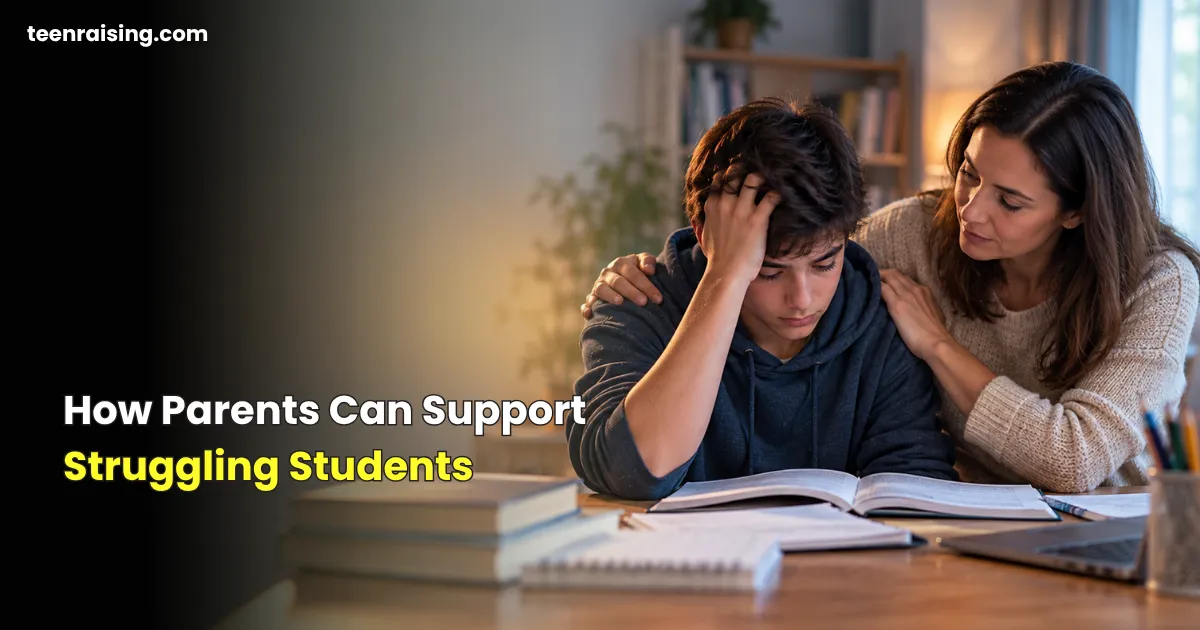

It hurts to see your teenager having difficulties at school.
The report card may have changed. What was once an hour-long homework assignment has become a source of frustration and conflict. Your teenager’s attitude could even be summed up by saying “I don’t care” when asked about school.
For parents, our natural tendency would be to solve the problem in an instant. We tell them to study harder, confiscate their cellphone, or inquire about why they are not making any effort. However, it is not always the case that a troubled student needs further stress applied to him.
How Parents can support struggling students without adding further stress to school life? It might start by asking the right questions.
Q1. How do I know if my teenager is really struggling in school?
A poor grade does not always point to a real issue. There are always hard courses, tough weeks, and bad grades for everyone.
If the problem continues consistently, it may be worth exploring further.
Some signs a student is struggling in school could be:
- Falling grades for several weeks or months
- Lack of assignments or not doing their assignments
- Trying to avoid discussion about school
- Complaining of headaches and stomachaches before school starts
- Getting frustrated when doing homework
- Problems with concentration and organization
- Bad attendance and attempts to miss school
- Being negative and calling themselves stupid
- All of a sudden disinterest in topics they once loved
The key is that one must consider the bigger picture. Your child might be facing student academic challenges in class, but other factors such as learning differences, anxiety, attention issues, social pressures, sleep deprivation, among others, can influence the performance of the teenager in school.
The American Academy of Pediatrics indicates that problems at school on a continual basis may be due to learning, behavioral, psychological, social, or health issues.
Questions to ask yourself:
“Is it that my child is uninterested in learning, or is there something getting in the way of his learning at the moment?”
It’s all a matter of perspective.
Q2. What should I say when my teen brings home a bad grade?
Breathe before you speak.
Being reprimanded by a parent or guardian for a poor grade may already leave a teen feeling ashamed, let down, or scared. Hearing anger in their initial reaction will teach them to hide any future issues.
Don’t say:
“Why didn’t you study?”
Try:
“I see this grade. What do you think about it?”
Or:
“Would you like to discuss why this assignment was challenging?”
This is one of the easiest methods of supporting struggling students at home. Your teen must understand that a grade is data—nothing more than that.
You still have your expectations. You will still talk about missing assignments. But relationships should come before correction.
Q3. How can parents support struggling students without doing the work for them?
It’s here that most parents become confused.
You would like to be helpful but do not want to sit beside your teen all night, telling him or her about every assignment.
The right way of doing things is to become a guide rather than a manager.
| Instead of doing this… | Try this instead… |
| Checking on every assignment | Ask your teen to share their weekly schedule |
| Reminding them all the time | Assist in making a system of reminders |
| Giving them all the solutions | Say “which part is confusing” to them |
| Working on a project for them | Divide the project into small steps |
| Concentrating on grades alone | Look out for efforts and consistency too |
In terms of considering how to help a struggling student, consider building the skills rather than creating dependency.
This would mean instead of saying something like:
“You have to complete all of them tonight.”
You say something like:
“You have three tasks. Which one seems easiest for you to start with?”
Q4. What if my teen says, “I don’t care about school”?
This is often one of the most frustrating things that parents hear.
But before you decide that your teen is lazy, consider another question:
“What was the event that caused school to lose its significance?”
Some teenagers claim they do not care as being involved is too dangerous.
After working their hardest but failing regardless, they may give up as an attempt to shield themselves from disappointment.
At other times, the problems that one teenager faces include:
- Fear of failure
- Test anxiety
- Problematic relationship with the teacher
- Bullying or peer relationship issues
- Learning disabilities
- Attention or organizational problems
- Perfectionism
- Depression or anxiety
- Feeling detached from school
The CDC reports that school connectedness is important. Those who feel that they are cared for, valued, and supported in school usually do well academically and have regular attendance records.
Therefore, instead of inquiring how your teenager can boost a grade, inquire:
“Are you still comfortable in school?”
This answer will surely shock you.
Q5. How can I help a child struggling in school when I don’t understand the subject?
Great! You don’t have to remember anything about high school algebra or chemistry in order to assist your teenager.
One of the best things you can do to help a struggling child is to provide him/her with the proper assistance.
You might try asking:
- Are there any teachers that you feel would be comfortable helping you?
- Do you need some additional tutoring?
- Can you go to office hours?
- Can you do some studying with your classmates?
- Can you break your assignments down into smaller steps?
It is not up to you to be the teacher.
It is up to you to help break down the barriers.
According to the Child Mind Institute, discussing your child’s behavior with his or her teacher and comparing your observations with those of the teacher can help. This approach can also be helpful for children.
In this way, your partnership can give academic support for struggling students without putting pressure on the teenager—or even the parent.
Q6. Should I contact my teen’s teacher?
Sure, particularly when you realize that the difficulties at school have been ongoing.
An email is a good starting point.
One may wonder:
- What are you observing in class?
- Does my teenager complete work?
- Do they participate?
- Are there certain skills that seem difficult for them?
- Is there any help available at school?
- Is there anything we can reinforce at home?
Try to view the discussion as a collaboration.
The teacher sees one side of your child’s life. You see another.
Together, you may be able to spot patterns neither of you can see individually.
Parental involvement is described by the CDC as an effort of parents and school personnel working together to help students learn and develop both academically and physically.
For parents helping struggling students, communication with teachers can often be the first important step.
Q7. What should I do at home to make school easier?
There is no need to make your home into a class.
However, some basic routines can be beneficial to the learning process.
On the other hand, there are many adolescents who require home to be their safe haven.
Try establishing an easy schedule for your school-going child:
After school:
Let your child eat and unwind first before asking anything related to homework.
Homework time:
Get them to locate a relatively calm place.
Breakdown big assignments:
Get them to concentrate on just one assignment at a time.
At bedtime:
Go over the schedule of the next day, the backpack, and any deadline.
Once a week:
Have a quick talk about any upcoming test or project.
Supporting struggling students at home is not about always being around.
It is about providing enough structure that they do not get lost.
Q8. Should I punish my teenager for poor grades?
Low grades do not necessarily indicate bad behavior.
Certainly, it can be justified to discipline a teenager who keeps on neglecting his responsibilities. Nevertheless, punishment cannot address the cause of the poor performance.
For instance, confiscation of a phone cannot assist students who:
- Do not understand the content being taught
- Feel nervous when testing
- Have more than one assignment at once
- Have difficulties organizing themselves
- Are scared of asking for assistance
Before determining any consequences, consider the following question:
“What problem are we really solving here?”
Occasionally, the answer may lie in adding structure.
In some cases, it might involve tutoring.
In other cases, it could mean talking to the counselor at school.
Sometimes, what the teen needs is just emotional support.”
Q9. How can I motivate my teen without constantly nagging?
This is a very common worry for parents.
The more that you nag some teenagers, the less that they want to listen.
Rather than saying:
“Have you finished your homework?”
Try asking:
“What do you plan on doing to get your homework done tonight?”
Rather than:
“You should improve your grades.”
Try:
“What is one thing that could help make this class more manageable for you?”
As recommended by The Child Mind Institute, the focus should not only be on the outcome, but also on the process of putting in effort and finding out what could be interfering with the motivation process.
How to improve a teenager’s academic performance
This strategy would be particularly useful when evaluating the academic performance of teenagers.
Motivation can increase when teens experience feelings of:
- Self-efficacy
- Encouragement
- Validation
- Trust
- Involvement in
Q10. What if my teenager is overwhelmed by homework?
Reduce the scope of the problem initially.
A teenager might see five assignments and say, “No way am I going to be able to do this!”
Show them how to make a small plan.
The 3-Step Homework Reset
Step 1: Write it all down
List out every assignment without having to worry about doing them yet.
Step 2: Decide your priorities
Which assignments need to be done first or carry the most points?
Step 3: Aim low
Decide to do something small like read two pages, answer three questions, or study for 20 minutes.
Starting with something small seems less intimidating than a larger task.
This is just one way that how parents can help with school struggles without making every night a battle.
Q11. When should I talk to the school counselor?
The school counselor can be of help when the challenges of your teen affect several subjects at once or when academic performance affects his or her emotional health.
Feel free to contact us if your child is:
- Unduly anxious about school
- Avoiding school
- Struggling with organizational difficulties
- Experiencing issues with friends or being bullied
- Finding it difficult to cope with pressure from school
- Unable to seek assistance from teachers
- Dramatically underperforming
Some learners may require extra assistance through various forms like classroom techniques, tutoring, school-based interventions, and evaluations. If it is required, then families can consider other types of assistance for their learner such as a 504 Plan and an Individualized Education Program (IEP).
You don’t need to go at it alone.
Q12. What if I think there may be a deeper reason behind my child’s struggles?
Trust your observations.
You know your teenager better than anyone.
If your child continues to have issues at school, even with help, it may be wise to consult their doctor about your worries.
Some ongoing issues may relate to learning, attention, emotional, behavioral, social or health issues. Receiving help does not mean that you label your child.
It simply means that you need to identify what will help him/her go forward.
This especially matters when helping a teen who is struggling in school emotionally drains not only them but also their parents.
Q13. What does good parent support actually look like?
At times, parent support for struggling students seems deceptively easy.
They say:
“This must be tough for you.”
“We’ll get through this together.”
“You don’t have to answer everything tonight.”
“What do you need to make this work?”
“A poor test result doesn’t describe you.”
“I think you will understand this, even if it takes some time.”
Not all the time will your teenager be responsive to you.
They may shrug.
They may say, “Whatever.”
But your support counts nonetheless.
How Parents Can Support Struggling Students: A Quick Checklist
| Ask Yourself | Helpful Parent Response |
| Do I know why there is a problem? | Listen before making assumptions |
| Have I talked to my child’s teacher? | Create a home-school relationship |
| Is my child too stressed? | Divide activities into small steps |
| Am I only concerned about grades? | Acknowledge attempts and progress |
| Does my child need more help? | Try a tutor or school assistance |
| Are other things having an impact on their learning? | Perhaps speak to a trained professional |
| Does my child feel supported? | Remain calm and supportive |
The Most Important Question: Does My Teen Know I’m on Their Side?
Ultimately, what parents can do to help failing students isn’t just about scheduling homework, tutoring, and report cards.
What matters is the bond that you form in tough times.
Your teenager may forget exactly what mark they earned in math in Grade 9.
But what they may remember is whether home was a place of safety after they had failed.
Whether you listened before offering any advice.
Whether in those challenging times you took a look at them and said:
“This is an issue that we can address. The student isn’t the issue.”
These words can actually make a huge difference.
Thus, if you wonder how to help a struggling student who is having difficulties at school, be patient. Be curious. Don’t lose connection to the school. Try to understand the root cause of the problem. But first of all, tell your child that asking for help is a normal thing.
Often, everything starts with one simple realization.
Trusted Resources for Parents
- HealthyChildren.org: What to Do If Your Child Is Falling Behind in School
- CDC: Parent Engagement in Schools
- Child Mind Institute: Getting Support From Your Child’s School
Related Articles:
Signs of Depression in Teenagers: 12 Warning Signs Every Parent Should Know
Social Media Effects on Teen Mental Health: What Every Parent Should Know