

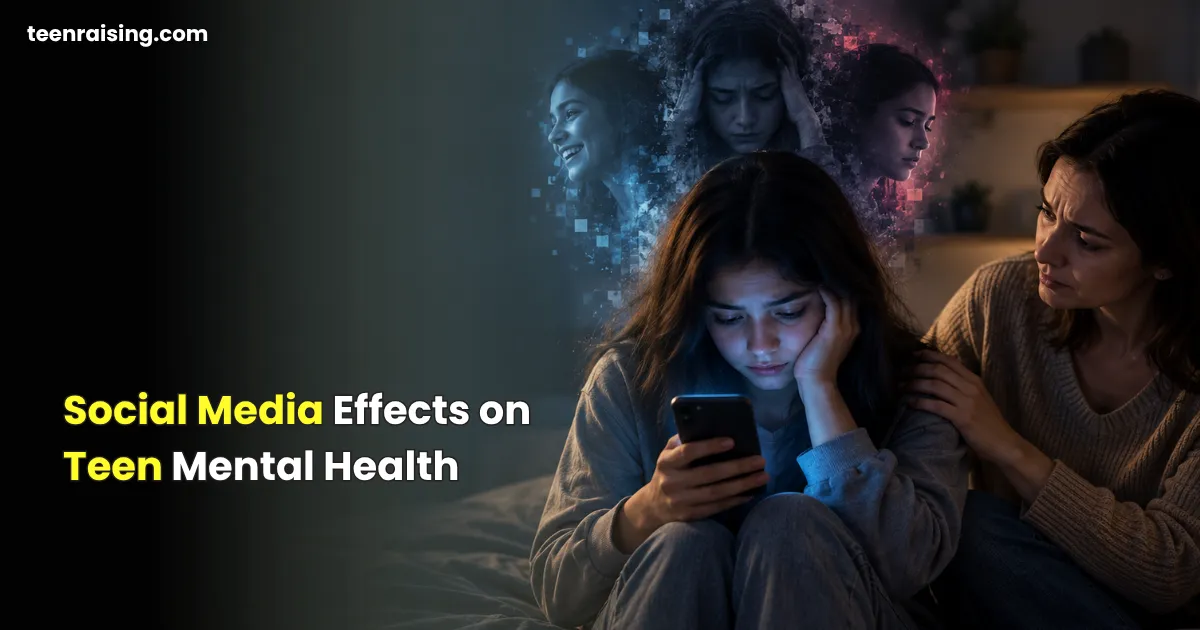

It is evident that social media has become an everyday aspect of teenagers’ lives. In many cases, the activity of sending texts, watching videos, posting pictures, and communicating with friends is done daily by teenagers. But as a parent, you may at times question yourself regarding the effect this has on your child.
This is far from the truth because the social media effects on teen mental health depends on various factors including how the teenager engages with social media platforms, the type of content he/she comes into contact with, his/her personality, and even his/her offline environment.
According to research as well as the guidelines provided by the American Psychological Association (APA), social media is neither good nor bad. It all depends on the individual teen and their experience online.
Understanding this would help parents guide their teenagers without turning each discussion regarding phones into an argument.
How Do Social Media Impact the Mental Health of Teens?
In terms of social media effects on teen mental health, it is crucial not to focus only on how much time a teen spends online since two teens can spend equal amounts of time online, but experience it differently.
A teenager can make good use of social media to keep in touch with supportive friends and explore his interests, while another might use the exact amount of time obsessing over how he looks, how many likes he is getting, and enduring cyberbullying.
That is why the association of social media with teen mental health becomes so complicated, as while social media has the ability to provide one with connections, it also has the capability of exposing teens to dangerous things.
That is why the issue of how social media effects on teen mental health is complicated since social media may help foster a sense of community and support, but on the other hand it may also expose people to negative influences.
Also read: Signs of Depression in Teenagers: 12 Warning Signs Every Parent Should Know
1. Social Comparison May Influence Teenage Self-Esteem
The first social media effects on teenage self-esteem is social comparison.
Social media provides teenagers with edited pictures, filtered videos, fancy vacation locations, perfect friends, and perfect bodies. Though teenagers know for sure that those images are edited or selectively chosen, the regular exposure to such things may have an impact on them.
The teenager begins to wonder why:
“I am not like that.”
“Everyone else is better than me.”
“Why didn’t I get invited?”
As time progresses, this comparison may result in low self-confidence, and may even lead to an individual being dissatisfied with their appearance or general life situation. It has been recommended by the American Psychological Association that the use of social media for appearance comparisons be limited.
The common causes of comparison may be listed as follows:
- Curated beauty and fitness posts
- Followers and likes
- Party posts
- Influencer lifestyle
- Achievements in academics or athletics
- The perpetual focus on appearance
Because of this, the topic of social media and body image in teens is one that should be discussed by parents.
2. Social Media Anxiety in Teenagers Can Worsen
Social media anxiety among teenagers can result when a teenager feels compelled to monitor their notifications, respond instantly, or maintain a particular online image.
Some teenagers are concerned about:
- Missing texts or chats
- Being left out of online conversations
- Having less likes than their peers
- Accidentally posting embarrassing material
- Bad comments
- Missing out on events they have seen online
The “fear of missing out,” also known as FOMO, makes it hard for teens to unplug.
A parent may recognize the teenager setting down the phone only to pick it up right away. The teen shows signs of being restless when they aren’t checking their notifications.
This is not necessarily a sign that the teenager has a mental disorder. Nevertheless, it should be noted if social media usage causes distress or affects their lives negatively.
3. Teenage Depression and Social Media: Explaining the Correlation
Parents sometimes wonder if there is any direct correlation between social media and teen depression.
Current studies do not enable researchers to state that social media always causes depression among teenagers. There are many sides to this correlation. For instance, a teenager suffering from loneliness or depression may use social media in ways different from those used by emotionally healthy teens.
Still, having a bad experience online, making unhealthy comparisons, being a victim of cyberbullying, disturbed sleep, and exposure to harmful material can raise the risk for vulnerable teens.
As a matter of fact, the U.S. Surgeon General claims that there is no evidence to confirm that social media is safe enough for children and adolescents.
Consequently, parents need to understand that they cannot blame every issue on a smartphone, but still have to take behavioral changes into account.
4. Cyberbullying and Teen Mental Health
As opposed to conventional bullying, cyberbullying may pursue a teen even at home.
Verbal abuse, images, rumors, or comments could be made available and spread easily. Thus, cyberbullying and the psychological well-being of teens are of utmost importance.
As per APA, cyberbullying, discrimination, and online hate can pose psychological dangers for youth.
Parents need to look out for the following signs in their kids:
- When the child suddenly stops using social media despite liking it before
- Becomes angry after looking at the phone
- Does not want to go to school
- Avoids friends and family members
- Is overly secretive about online interactions
- Mood swings
In case of cyberbullying, try beginning with questions instead of immediately confiscating the cell phone. Many teenagers are worried that reporting to the adults will lead to cutting off from all their contacts.
5. Sleep Issues May Impact Psychological Well-being
A further vital area regarding the impact of social media on adolescent mental health is sleep.
Using the smartphone at night may delay going to bed. Moreover, notifications and stimulating content may hinder the process of relaxation.
According to the APA, using social media should not hinder the individual from sleeping or exercising and states the connection of using technology at night with sleep disruption.
Poor sleep might affect one’s mood, concentration, emotions, and mental health in general.
An easy family guideline, like recharging phones in another room or avoiding screens in the evenings, might work. The idea is not to get into a battle but to create good habits.
6. Problematic Use of Social Media May Affect Your Everyday Life
Social media addiction in teens is the phrase which many parents use, but it is better to concentrate on behavior rather than labeling.
The APA talks about “problematic use of social media” when use starts getting in the way of your daily activities.
Some warning signs might be:
| Possible Sign | What Parents May Notice |
| Loss of control | Your teen spends much longer online than intended |
| Difficulty stopping | They become highly distressed when asked to log off |
| Neglecting responsibilities | Homework, sleep, or activities are regularly ignored |
| Constant preoccupation | They seem unable to focus without checking social media |
| Relationship problems | Online use repeatedly creates conflict or isolation |
One’s engagement in one form of behavior is not an indication that there is a serious problem. Patterns and interference in the child’s education, sleep patterns, relationships, and day to day activities should be considered.
Positive Impacts of Social Media on Teenagers
The discussion on the social media effects on teen mental health should also involve some positive outcomes.
Social media may positively impact teens by:
- Connect with your friends and family members
- Join communities of like-minded individuals
- Conduct creative activities
- Get educational information
- Get emotional support
- Find people who understand you
- Conduct creative self-expression
For some teenagers who are alone in their real life, good communities in the virtual world can become an important source of support and connection. The APA understands that having friends and emotionally connecting to someone in the virtual space may be beneficial for the socialization of teenagers.
This is why forbidding teens from using social media is not always the best solution.
Also read: Resolving Family Conflicts Calmly: How to Turn Teen Arguments Into Opportunities for Connection
How Parents Can Help Their Kids Have Healthy Social Media Habits
The right way is often through guidance, conversation, and sensible limits.
1. Ask About The Content That Your Child Is Viewing
Don’t just ask, “How long have you been on your phone?” Instead, ask:
- “What type of videos/content are you watching on the Internet?”
- “Have you ever come across anything online that made you feel uncomfortable?”
- “How often do you feel worse about yourself after spending time on social media?”
- “Who do you normally talk to online?”
These questions could lead to significant discussions.
2. Quality Counts More than Screen Time
How social media affects teenagers often hinges on their activities online.
While the teen video chatting with an encouraging friend is having a completely different experience, compared to the teen constantly watching appearance-based content.
Encourage your child to think of how various accounts and platforms make them feel.
3. Establishing Family Boundaries Together
The American Academy of Pediatrics recommends that families establish good media habits together by means of discussion and household guidelines, and parents should act as role models for the kids.
Set boundaries for:
- mealtimes,
- bedtimes,
- study time,
- family discussions,
- any private or dangerous online communications.
Try to get your teenager to help set the boundaries wherever possible.
4. Teach Digital Literacy
Urge your teen to be skeptical about what they see online.
Remember that:
- Pictures can be altered
- Influencers might have been paid for promoting a product
- Someone being popular doesn’t mean they’re happy
- Similar things might be shown repeatedly by an algorithm
- Viral information might not be accurate
Digital literacy will help lessen the emotional effect of unrealistic information.
5. Be Alert to Changes in Your Teenager
The most obvious warning sign is not usually how much screen time they are having. It’s whether you can see any changes in your teenager.
If you think your teenager might be depressed, anxious, withdrawn, experiencing big sleep changes, or struggling emotionally in some way, seek help from professionals.
Signs of Unhealthy Social Media Use in Teens
Parents should watch out if they see these characteristics combined:
- Social media always makes their teenager feel bad
- Their teenager has trouble sleeping due to midnight scrolling
- They constantly unfavorably compare themselves to others
- They get extremely anxious when they cannot get access to social media
- Their online disputes start affecting their education or relationships
- They withdraw from things they used to like in real life
- They are victims of cyber bullying
These signs of unhealthy social media use in teens do not necessarily imply that every teenager has to give up its usage. They only imply that their current approach needs modification.
Conclusion: Connection Is More Important Than Control
Not all teens will be affected by the social media impacts on their mental health. There are opportunities for social media to foster connection, learning, and even support.
On the other hand, there is potential for comparison, cyberbullying, inappropriate content, and even pressure to occur.
As a parent, you don’t need to know everything about the latest apps and trends.
What is of prime importance is to develop a relationship where your teen feels comfortable approaching you.
Rather than making social media the culprit, focus on becoming your teen’s guide. Remain interested in their online activities, set some limits, and observe how their online activity impacts their emotional health offline.
The objective is not only to reduce screen time. The objective is healthier and safer screen time usage.
Also read: School Anxiety in Teens: What Parents Need to Know


[…] Social Media Effects on Teen Mental Health: What Every Parent Should Know […]